Grasshoppers and Giants: Sermon for Yom Kippur, 5787

September 21, 2026

Westchester Reform Temple, Scarsdale, New York

The bad report reached me an hour before Shabbat services on April 17th, the Sabbath bookended by Yom HaShoah, Holocaust Memorial Day, a few days before, and Yom Ha-Atzma’ut, Israel’s Independence Day, just after.  

That afternoon, posters advertising the Scarsdale High School Israeli Culture Club’s Yom Ha-Atzma’ut celebration had been torn down and stuffed into urinals in boys’ bathrooms where they were further desecrated. Images then circulated on social media, fueling an all-too-familiar cycle of mutually assured outrage. 

And precisely because incidents like this have become all too familiar, we’d do well to give some thought to how we should respond.  What would constitute the best possible Jewish response to such provocation?  

Problems like the one I have described are not solvable with enhanced security measures. Just five weeks before the incident in our village, a jihadist sympathizer rammed his truck into a prominent Reform Temple in West Bloomfield, Michigan and stormed the building, rifle in hand. Only one person, the attacker, died that day. Temple Israel had drilled nightmare scenarios like this for years, as have many synagogues, including the one you’re sitting in now.  

But concrete barriers can’t stop students from harassing other students. Guns and metal detectors have no effect against the spread of hate on social media. And lockdown drills won’t teach basic empathy and respect.

There is Torah for every experience, and the Torah that came to mind in this instance comes from the Book of Numbers. The story goes like this. As the Israelites prepare to cross over the River Jordan and enter the promised land, twelve spies enter Canaan, one from each tribe, to scout out the territory and its inhabitants. After forty days they return and report that, as promised, the land flows with milk and honey; its fruit is lush and abundant. However, the inhabitants are powerful and their cities fortified.  Breathlessly recounting their exploits to Moses and Aaron, the spies bring back what the Torah calls “dibat-ha’aretz ra’ah” (Num. 14:37), “a bad report about the land,” and the rumors they spread became more extreme and grotesque in the retelling. “The land we traversed… devours its settlers,” they say. “We saw the Nephilim there,” they say, referring to a legendary race of giants. And then these damning words: “We looked like grasshoppers in our own eyes, and so we must have appeared to them” (Num. 13:33).

The Israelites, hearing the bad report, weep inconsolably. They turn against Moses and Aaron, begging to return to Egypt, cursing their leaders and the God who delivered them from slavery only to meet an untimely end in the jaws of giants.

God punishes the faithless spies, and all whose hearts turned against entering the promised land, with a self-fulfilling prophecy: They will not in fact enter Canaan but wander forty years – one year for each day that the spies scouted the land – until their “carcasses drop in the wilderness,” as the curse is memorably preserved (Num. 14:32).

I first learned this story from Professor Julius Lester.  As a student at Amherst I occasionally attended Hillel services down the road at UMass where Lester, then faculty in the Judaic Studies department, regularly served as a lay chazzan. He would daven the prayers in a baritone rich with gospel flavor.  

In the 60’s, Julius Lester had been a folk singer and activist inside the Black Power movement. His first book, published in 1968, was called Look Out, Whitey! Black Power’s Gon’ Get Your Mama! He was a gifted writer, a radio show host, a guitar and banjo player, and a man who had once been accused, publicly and painfully, of antisemitism.

An encounter with Rabbi Yechiael Lander, who would eventually be my Hillel rabbi up the road, changed the course of Lester’s life. They began to meet regularly for coffee and conversation. Lester shared that at the age of seven, he learned that his maternal great-grandfather, Adolph Altschul, was a Jewish immigrant from Germany, who married a freed slave. 

In 1982, with Rabbi Lander presiding, Lester converted to Judaism.

Many years later, I learned from him this Torah about the spies who are suffering from a bad case of what Lester called “grasshopper syndrome.” “It seems axiomatic,” he said, “that how we see ourselves determines how we see others. If I am a grasshopper to myself, then others will appear as giants to me.” 

“Frequently,” he noted, “Jews see themselves as grasshoppers and thereby transform ‘goyim’ [his word, not mine] into giants.”

“Psychologically,” he continued, “how much of contemporary black anti-Semitism is nothing more than blacks seeing themselves as grasshoppers and making giants out of Jews?” (Lester, “Seeing Ourselves as Grasshoppers,” National Havurah Committee, 1989).

Six years after his conversion to Judaism, Lester’s public criticism of black antisemitism led to a painful rupture with his colleagues in the Afro-American Studies Department. The Department of Judaic Studies took him in.

Lester had the courage to turn the question on his own community of origin. Yom Kippur demands we do the same. How much of what we Jews face today is a confrontation with actual giants, and how much is grasshopper syndrome, making giants out of others? 

Jewish tradition gives us a useful scale for calibrating our response to provocation. On one side of the scale, we can respond with din, the Hebrew word meaning justice. To respond with din in a court setting means that discipline is not withheld from those who deserve it, and that the punishment fits the crime. Justice is served. On the other side of the scale, Jewish tradition places rachamim which means compassion – the ability to respond with mercy, recognizing that even wrongdoers must nevertheless be regarded as human beings with human limitations and human failings.  

Even God, the Talmud tells us – and this is one of those quintessential Yom Kippur teachings – wrestles with which impulse to follow in response to our transgressions. The Talmud asks, with fantastic audacity, “When God prays, what does God pray?” The answer the Rabbis give:  

May it be My will that My mercy will overcome My anger…

May I conduct myself toward My children… with the quality of rachamim, and may I approach them in a way that goes beyond the letter of the law (Bavli, Berakhot 7a).

Jewish tradition never casts aside the need for din, justice. But if God’s own prayer is a plea to temper anger with compassion, it is surely our obligation as well. Although, let’s admit it: it’s hard to summon rachamim when we are provoked.   

When I heard that bad report from Scarsdale High School, I understood our community’s rage because I felt it too. But the Talmud imagines God taking a breath before acting. In this case, productive conversations already underway with the school board, administration, village leadership, and community-at-large had to compete with threats of lawsuits, demands for resignations, and public shaming of family members implicated in the affair. Such responses, I fear, display din without rachamim. They risk turning a legitimate demand for accountability into a counterproductive cycle that diminishes us. 

In all this I heard an echo of the spies’ lament: “We looked like grasshoppers in our own eyes, and so we must have appeared to them.” 

Are we facing giants, or are we making them?

The question becomes harder, and more urgent, as we move from Scarsdale to New York, from a high school bathroom to City Hall. There, a new mayor has made relentless hostility to Israel a signature of his public voice. And he is not alone. This summer’s Senate primary in Michigan suggests a rising generation of political figures singularly fixated on the Jewish State: the one country whose very legitimacy is treated as an open question.

The concern is real. I share it. You don’t need me to catalog it from the bimah; many of you carried it into this room today.

And still, on this day of self-examination, we should ask: Is the mayor a giant, or have we made him one? 

The coming years will turn on our answer. This moment demands the discipline to discern a threat from a provocation, an armed terrorist from a rhetorical flamethrower.

That discipline is not only a public responsibility. It is a profoundly personal one. Every person in this room understands “grasshopper syndrome” because at one time or another every one of us has experienced it. It’s not just a Jewish communal pathology. It’s a human tendency.    

Even Moses speaks about himself as incapable of the very thing God calls him to do.

“I am not a man of words” (Ex. 4:10).  

“I am slow of speech, slow of tongue” (Ibid).
“Who am I to go to Pharaoh?” (Ex. 3:11).

“Please, send somebody else” (Ex. 4:13).

Notice what the Torah says and what it does not say. The Pharaoh is real. The Pharaoh is powerful. The Pharaoh held the life or death of his subjects in his hand. It also doesn’t say that Moses’s speech impediment isn’t real. The point is not merely that Moses is afraid; who wouldn’t be? The point is that he seems to have constructed an entire identity out of his deficiency: I am not someone who can do this. 

And yet the man who said, “I am not a man of words” ends his life giving the longest and most eloquent speech in all of Torah, the Book of Deuteronomy, whose Hebrew name – Devarim – simply means, “words.” Moses overcame his grasshopper syndrome to emerge our greatest leader, the man whose words would change the world.

We live in a world full of Pharaohs. They are real. They are powerful. If you feel adrift in a world that reels all around you, you are not alone. But the catastrophic conclusions we make about ourselves, our own capacity, our own agency, too often become self-fulfilling. I lost my job becomes I am unemployable. I feel alone in my marriage becomes I am unlovable.  I failed at something becomes I am a failure.  

Johannes Brahms destroyed so much of the music he composed as a young man that scholars estimate he burned more of his manuscripts than he ever allowed to be published. Twenty string quartets went up in flames before he published his Opus 51. Explaining why it took him over twenty years to complete a first symphony, he said, of composing in Beethoven’s shadow, “You have no idea how it feels to hear behind you the tramp of such a giant.”    

There’s the pain we inflict on ourselves, knowingly or not; there’s also the pain life inflicts on us. The call from the doctor that changes everything, even how time is measured: no longer month to month, year to year, planning the vacation, but day to day, minute to minute, waiting for test results. It’s all real; it’s all hard; and the question that matters is this: how can we remain the authors of our lives and not just characters in a narrative we did not write? 

Yom Kippur reminds us that agency remains even when circumstances are beyond our control.

For, yes, on the one hand, it says:

בְּרֹאשׁ הַשָּׁנָה יִכָּתֵבוּן, וּבְיוֹם צוֹם כִּפּוּר יֵחָתֵמוּן…

מִי יִחְיֶה וּמִי יָמוּת….

On Rosh HaShanah, it is written; on Yom Kippur, it is sealed – …who shall live and who shall die (“Unetaneh Tokef,” Machzor).  

Written. Sealed. Life. Death. It sounds like a fixed decree.  

But if that were truly the case, we’d read the decree on Yom Kippur morning, and go home to weep, because where is the agency in a fixed decree? How do we write our own story when the book is already written?

But the book isn’t already written, and that’s the whole point of Yom Kippur.  

The spies heard factual data and forged it into a fixed decree. We looked like grasshoppers in our own eyes. Their takeaway: I am not someone who can do this.  

God responded to their grasshopper syndrome in kind: With an outlook like that, you can never enter the promised land. The Mishnah refers to the punishment as a decree:  נִגְזַר עַל אֲבוֹתֵינוּ שֶׁלֹּא יִכָּנְסוּ לָאָרֶץ – It was decreed upon our ancestors that they would not enter the land (M. Ta’anit 4:6).

But Yom Kippur insists the decree is not fixed, not sealed, that teshuvah, tefillah, tzedakah ma’avirin et ro’a ha-g’zeirah, that our teshuvah – the re-aiming of our gaze, our tefillah – our sincere reflection and spiritual intention, and our tzedakah – our righteous and empathic action – that all these, together, can temper the harshness of any would-be decree. It is not forever fixed. We are still fixing it. 

Our story has an epilogue. Two spies, it so happens, broke ranks. Caleb and Joshua received the same data about the land but did not lie down inside a decree. “Caleb hushed the people before Moses and said, ‘Aloh na’aleh! Let us by all means go up, and we shall gain possession of it, for,” as it says in Hebrew, “yachol nuchal lah,” “we can, for sure, do this” (Num. 13:30).  

Caleb is the hero this moment needs. By refusing to turn a report into a decree, he went forward. In the face of giants, Caleb stood firm.  

People convinced of their own essential smallness will cower, lash out, fail to act from a posture of self-confident dignity. Caleb’s assertion, “we can, for sure, do this,” isn’t bravado. It’s hard-won self-confidence. It’s the stance of someone who has accepted the tough reality of the situation and has also internalized God’s charge to the Jewish people: to enter the land promised on oath to our ancestors, to claim our destiny. 

Caleb is a hero, but he’s not a superhero. When God explains why Caleb, of all that generation, will enter the land, God names one thing: ר֤וּחַ אַחֶ֙רֶת֙ עִמּ֔וֹ – “a different spirit was with him” (Num. 14:24).  

That’s all. Caleb had a different ruach, a different spirit: a different way of looking at things, or, more to the point, a different way of looking at himself. His fellow spies looked in the mirror and saw grasshoppers. Caleb saw a leader. Caleb saw a human being, a Jew, no less, fully capable of overcoming the obstacles ahead, relying, above all, on a pure heart, a willing spirit, and his trust in God’s promise. And so he said:  “Aloh na’aleh – Let’s do this. Let us by all means go up.”

What would “going up” look like for us, this new year? 

It would begin on the inside. With a mindset. A stance. A posture of self-confident Jewish dignity. It would look like showing up for your Jewish community, your WRT family, because we’re all in this together. It would mean asking not, “What are they doing to us?” but rather, “What am I building?” 

Wear that Star of David near your heart – it’s called a Magen David, a Shield of David! a reminder of your resolve. Run for the school board instead of berating it. Fund the institutions that will outlast the provocation. Buy the cookies for the Israeli Culture Club’s next event. Small acts that will register as major empowerments – both in here, and out there.     

The next provocation that comes to our community will be our proving-ground.  When it comes – and it will come – I hope you’ll remember Professor Lester, and ask yourself: “Will I answer as a grasshopper or with a different spirit?”

Let’s do this. Let’s go up.

G’mar Chatimah Tovah: May God seal us in the Book of Life — not as passive characters, but as partners in writing what comes next.

What Are We Doing Here? Sermon for Kol Nidre 5787

September 20, 2026

Westchester Reform Temple, Scarsdale, New York

I can tell from the sheepish look how the conversation is going to go even before the office door closes behind us. “I really don’t know why I’m here, rabbi,” it begins. “I’m not religious.” “And I don’t believe in God.”

I answer: “Now that that’s out of the way, what brings you here?”

I imagine some of you feel something like this every time this season rolls around. Maybe you think to yourself, “Why do I do this? I don’t even believe in organized religion.”

But, here we are.

So now that that’s out of the way, can we talk about what brings us here?

This is a love letter to all of us who are wondering what we’re doing here. (And, no worries, I love all of you who aren’t wondering, too.) But for all the wonderers and the wanderers: come in, get comfortable. Maybe you don’t believe in God. Or organized religion. Or even disorganized religion. Or maybe you don’t know what you believe. You’re not alone. Trust me. Just look around. 

And let me be bolder still: you’re in luck. Because while Judaism is religious, it is really so much more than what modern people usually mean when they say “religion.”  

Tonight, on the holiest night of the year, let’s come up with a better way of understanding what we’re doing here.

What are we doing here?

In the narrowest sense, we’re here for Kol Nidre. I know people – you probably do too – who become dues-paying members of a synagogue for this one service, this one prayer.

Kol Nidre actually argues against Judaism as a religion. If Judaism were just a religion, you’d expect a prayer to headline the holiest night of the year; if a belief system, a creed, a profession of faith.

But Kol Nidre isn’t a prayer. For starters, there’s no Baruch Ata Adonai – no mention of God at all. It’s not in Hebrew. It’s in Aramaic, the ancient Jewish vernacular – the language of commerce and contracts – and, fittingly, Kol Nidre is a dry legal instrument that annuls vows.

Kol Nidre first appears in the literature as a formula for invalidating vows taken over the past year. In the 9th Century, Natronai Gaon, head of the Rabbinic Academy of Sura in Babylonia, condemned it as a dangerous legal practice. An entire congregation cannot have its vows collectively annulled this way, he argued; such matters must be weighed case by case. His successor Amram Gaon called the recitation of Kol Nidre a minhag shtut, a “foolish custom.” For centuries, authority after authority agreed.

Then something happened. In 12th Century France, some of the greatest legal minds of the age declined to condemn and instead repaired the text, changing it from past tense to future, so that Kol Nidre preemptively releases vows made between this Yom Kippur and the next. They gave technical explanations, but I suspect the real reason: they knew the people would never give it up.

Kol Nidre also created an optics problem for us: Gentile onlookers concluded that a Jew’s oath couldn’t be trusted, a pretext Christian communities used to force Jews to swear special oaths in court. This, despite the fact that Kol Nidre only ever could annul vows between people and God. It could never cancel a promise owed to another person — no debt, no contract, no obligation, no injury. 

In 1839, Samson Raphael Hirsch, father of Modern Orthodoxy, abolished Kol Nidre from his first congregation but it reentered the service not long after. Our Movement originally cut the text of Kol Nidre from the machzor, but, and this is truly astonishing, the melody stayed: the Union Prayer Book kept a service called Kol Nidre in which the ancient chant was played on the organ, the words gone, the tune untouchable. Gates of Repentance eventually restored the full text because the people wanted it back.

The real story of Kol Nidre is this: the authorities opposed it for a thousand years – restricting it, revising it, removing it. But the Jewish people refused to give it up. They packed the synagogue for it. They named the holiest night of the year after it. And they did so, manifestly, not because of its content, but because of the melody and the moment, the experience of standing together as a People as the sun sets, with the Torah scrolls brought forth from the holy ark and the ancient chant rising from the depths.

What begins its strange and strangely durable life as a dusty legal technicality ends up, instead, as a magnificent window into the genius of Judaism. Kol Nidre teaches us that Judaism is not merely a religion, but a civilization – in which the common folk may ultimately prevail over even the greatest Rabbis who ever lived. Not a belief system, but a conversation – one in which every voice adds its unique Torah to the treasure-house of accumulated Jewish wisdom. Not a faith, but an invitation to awe – to feel the sacred within the dross of our frail and fleeting existence.

A civilization.

A conversation.

An invitation.

Three answers, I think, to the question we carried in here tonight: What are we doing here?

So another question. Have you ever heard of a game called Methodist Geography?

No, because, that’s not a thing.

Methodists are united by creed and church. Methodism is a religion. Methodists don’t play Methodist Geography.

Judaism, in contrast, is a civilization. Other religious traditions have rich cultures and communities, of course. But Jewish belonging has a particular thickness to it: we are united by peoplehood, a shared sense that a fellow Jew is mishpoche, family. Jewish Geography is our favorite pastime. Someone who wants to know what synagogue you belong to is most likely not trying to size up your theology. It’s about the people. Especially now that even Jalen Brunson’s got game. 

Rabbi Mordecai Kaplan, architect of Reconstructionist Judaism, built his entire body of teaching on exactly this idea in his 1934 book, Judaism as a Civilization: Toward a Reconstruction of American-Jewish Life.

Rather than work within the traditional conception — God revealed the Torah to Moses at Sinai and gave it to the People of Israel — Kaplan inverted the flowchart: Judaism begins with the People of Israel, who wrote the Torah to capture their experience of the Divine, and to express the claims that experience makes on our lives.

So yes, we’re a religious civilization, but religion is only one piece of our identity. What makes Judaism Judaism also comes from our shared languages and culture, our folkways and our food-ways; our ethics and our arguments; our Nobel prizes and our genetic disorders; our pride when a fellow Jew succeeds and our shame when a fellow Jew does something disgraceful; our sense of shared history and shared destiny; our neuroses and psychic fixations; our music, literature, and art; and our humor – especially the inside jokes. Ordering pastrami on white bread with mayonnaise at the deli may be kosher, but it sure isn’t Jewish.

I think if we all related to Judaism as a civilization, we’d have a lot less Jewish guilt, a lot less “I’m not a good Jew,” and a lot more comfort and joy in Jewish settings. No one in this room is “less Jewish” for what you do or do not believe.

Judaism-as-civilization also rebuts the argument that we can divorce Judaism from Israel. If Judaism were just a religion, sure – one could be Jewish with no connection to Israel whatsoever. But we’re more than what we pray or believe: we are an Am, a people, the collective expression of just under sixteen million Jews, nearly half of whom live in Israel – a civilization within the civilization. Our civilization has carried the land in its history and memory for three thousand years: in our calendar and customs, our poetry and yearning.

Israel is not the whole of Judaism, of course. But neither can we tell the story of Judaism while pretending that Israel is irrelevant to our peoplehood.

You may fall in and out of love with Israel. You may be proud of Israel, worry over Israel, kvell over Israel, weep for Israel, argue about Israel at the break-fast tomorrow. Go ahead, it’s okay. Because in the Jewish civilization, arguing is not the opposite of belonging; it is often a form of belonging. 

And that takes us to our second insight: that Judaism is a conversation – one in which every voice adds its unique Torah.

Kol Nidre itself, you will recall, is Exhibit A: the people defied their Rabbis and kept it right where they wanted it.

You came here tonight to be part of that conversation – a conversation about, well, everything. The Talmud is a conversation spanning centuries, among hundreds upon hundreds of rabbis who lived lands and generations apart: a great unfolding of arguments, as dense as kugel, as layered as baklava, as deep as the profoundest questions of philosophy, cosmology, psychology, law and life.

“Judaism,” my friend and rabbi Larry Hoffman likes to say, “is a conversation in a register that does justice to the human condition.”

I was thinking about that line this summer as I walked through Auschwitz with Cantor Kleinman, fifty members of our WRT family, and four educators: two Israeli and two Polish. Judaism is a conversation in a register that does justice to the human condition.

Here we stood, on a late June day in the heat wave blanketing Europe, in that most inhuman place, where the Nazis murdered a million of our people, and a hundred thousand others – Poles, Roma, Sinti, Soviet prisoners of war – either through a slow death of forced labor, disease, and starvation at Auschwitz, or a terrifyingly abrupt end in the gas chambers and crematoria of Birkenau just up the road. And I thought about what Judaism had to say to us who came to bear witness.

For some who entered the camps, piety – the specifically religious part of Judaism – sustained them. I thought of Eli Sharabi, an Israeli abducted by Hamas on October 7th, whose 491 days in captivity in the foul tunnels of Gaza inform his memoir, Hostage. When I interviewed him on this bimah last December, he told us that – never having thought of himself as religious – he and his fellow captives drew strength from making kiddush on Friday nights with what little water their captors provided. 

His story reminds us that ritual and prayer can hold the hearts and souls of the suffering when all other words fail or fall away.

The moment came for Cantor Kleinman and me to lead a short service of memorial. Standing, sweltering, seeking the meager shade of a cattle car preserved in the vast expanse of the extermination camp, we found ourselves craving and creating ritual.  The moment needed our attention. It needed Kaddish.  It needed a melody older than our grief.  

It did not need many words, and I did not have many.  What I had was this:

Judaism didn’t come into the world to make us more observant, or make us more fervent believers. Judaism came into the world to help us become more fully human. More human, so that we could see the brokenness and be the repair, so that we could stand in the darkness and be a light.

Hillel gave us six words that Auschwitz turned into a commandment: Bamakom she-ein anashim, hishtadel lihyot ish. “In a place where no one is a human being, strive to be human” (Pirkei Avot, 2:5). 

Auschwitz tells us, with unbearable force, why Jewish safety and sovereignty matter, why the world needs Israel. Yet just as much Auschwitz teaches, with terrible clarity, why the world needs Judaism: a conversation that insists on the sacredness of every human life.

As the world becomes, day by day, more inhuman, can we be a force for this humanizing holiness? Can we once again live inside that conversation that does justice to the human condition? That is the real work of this day. 

I’ll let you in on a secret.  Getting to that conversation requires that we first stop talking long enough to pay attention: to notice, in silence, the person in front of us, the lives surrounding us, the world holding us.

Which brings us to the third answer.

Judaism is, above all, an invitation to awe. And I want you to hear it from one of its greatest proponents. Rabbi Abraham Joshua Heschel fled Warsaw just weeks before the Nazi invasion, rescued by the President of Hebrew Union College, our seminary. His mother and three of his sisters were not saved. This man, an ember plucked from the flames, is the one who spent the rest of his life teaching that the ground note of Jewish existence is amazement.

For Heschel, amazement isn’t a reaction to the unusual; it’s the baseline posture Judaism invites us to adopt toward all of existence, the mundane no less than the magnificent.

Awe is what we feel gazing out from the mountaintop. But it’s also there in a perfect scoop of gelato. In the look from your loved one that means something only the two of you know. In waking up after a good night’s sleep. In the sound of your grandchild’s laughter. For Heschel, the capacity “to experience commonplace deeds as spiritual adventures” is “one of the goals of the Jewish way of living” (God in Search of Man, 1955, p. 49).

If you are capable of being astonished, you are already on the starting line of a Jewish life. Everything else flows from awe: the ability to see another human being not as an object to be exploited but as an image of the holy; the willingness to live in covenant with creation, as partners in mending a broken world; the bravery to show up amidst that brokenness and still carry ourselves with gratitude for the mystery and majesty of it all.

We stand at every moment, in this too-short life, in a world where heart-stopping beauty and heart-rending pain intersect. Judaism invites us to stop, regularly, to answer the world with the only response it deserves: our awe.

These are, after all, Days of Awe, Yamim Nora’im. Our tradition named them after an experience, not a belief. No one will leave this sanctuary having signed a creed. Everyone can leave having felt something true: what forty generations have felt when the melody of Kol Nidre begins.   

We would – if we stopped and took notice – make not just these ten days in September, but every day after, days of awe, lowercase. Let the way we see and treat each human being, each image of the Divine, be our living and breathing Judaism. Let our conversation do justice to the human condition and our deeds give honor to the civilization of the Jewish people. And even when no one else is acting like a human being, let our Judaism remind us to strive to be as human as we can be.

So the next time you find yourself at my door, and you feel the old disclaimer coming on – “I’m not religious, but…” – just come into my office. Because now you know: that was never the question. You are a cherished part of a civilization. You are an essential voice in the conversation. You are invited tonight, and every day you draw breath, to live in awe. 

And that is what we’re doing here.

G’mar Chatimah Tovah.

ON GOD’S MOUNTAIN, THERE IS VISION: Sermon for Rosh Ha-Shanah Morning, 5787

Delivered September 12, 2026, Westchester Reform Temple, Scarsdale, New York

He found himself staring into the sky: moments before, blue as a daydream, now thick with smoke and ash. It flooded his nostrils, seared his throat, stung his eyes. He willed his arms to move but found them bound to his side. His body had gone to stone. Every muscle froze except his eyes which darted back and forth in search of a face. His vision blurred in the haze. The sky turned red and black, sheets of fire and soot, floating down, rising up in plumes, smoldering embers scattered on the ground, the glint of metal piercing the air, the ringing in his ears, the fear that pinned him down.

This he knew: if he ever made it out of this alive, nothing would ever be the same.

He heard a voice. It sounded like father muttering to himself, talking himself down the way mother did when father was being headstrong, impatient, impervious to reason. “Abraham, Abraham.” The knife clattered to the ground. Father’s fists unclenched. Isaac’s stayed balled up, a knot of tendon, muscle, and bone.

He remained immobilized, bound in place, eyes closed tight, ears straining to stifle the sound – father’s footfalls crunching this way and that, a high shrieking noise, desperate and inhuman, that seemed to go on for hours, and then nothing. Nothing, but a still, small voice, a low murmuring sound. Father breathing, slow and heavy.

Isaac blinked his stinging eyes and squinted to survey the ruin: the broken stones and fuming cinders, the blood soaking into the gravel, the smell of the ram upon the altar, its mangled body turning black as it went up into the sky as a burnt offering, father low to the ground, hunched over, the wreckage of a man.

They would not walk on together after this. How could they?

They stood together for a moment, father and son, atop Mount Moriah. Before turning his back and trudging off, Abraham would give this place a new name, this ground zero where, in a few terrible hours, everything changed.

וַיִּקְרָ֧א אַבְרָהָ֛ם שֵֽׁם־הַמָּק֥וֹם הַה֖וּא יְהֹוָ֣ה ׀ יִרְאֶ֑ה אֲשֶׁר֙ יֵאָמֵ֣ר הַיּ֔וֹם בְּהַ֥ר יְהֹוָ֖ה יֵרָאֶֽה׃

Abraham named that site Adonai-yireh – the place where God sees – of which it is said, even today, “On God’s mountain there is vision” (Gen. 22:14).

Adonai yireh, the place where God sees. 

Today, on this Rosh Ha-Shanah morning that marks the 25th yahrzeit of 9/11, and nearly three years since October 7th, we try to see; we look back with Jewish eyes.

Today we undertake a “spiritual eye exam”: not to test our eyesight, but to examine what we’ve chosen to look at, and what we’ve closed our eyes to. What, since 9/11, have we failed to see? And what, since October 7th, might we choose to envision differently? How, especially now, might we move from Moriah – the mountain of trauma – to Adonai-yireh, the vista of vision? How can we transform suffering to seeing, wound to witness?

Three days after 9/11, at Friday night services, a hundred members of our WRT community came up to the bimah to bensch gomel, the tradition of reciting a prayer for those who’ve survived a brush with death. Some of you were there, had seen it all and lived to tell: the fire and the ash; the towers disintegrating into heaps of twisted metal and shards of glass; the bodies, broken and plummeting. Paralysis was momentary. Unbound from Ground Zero, that unholy altar, survivors picked themselves up and began to run, block after block, through smoke and debris.

And we witnessed along with them, on our TV screens, these images none of us can ever unsee. We saw this as well: the feet of first responders surging into the flames, hands sifting through the rubble; the posters of the missing; the strangers turned supporters; the flags and banners on the balconies, the city that refused to surrender to fear. On 9/11 we saw the worst of humanity; in the hours and days that followed we saw the very best.

And yet much, still, we did not see, not clearly, not at the time. We may have heard reports of cheers erupting from East Jerusalem and the West Bank, of candy strewn across the streets of Gaza City and Nablus, presaging the gleeful scenes immediately following the butchery and kidnappings of October 7th. But we failed to see how the masterminds of 9/11 rooted their rationale in a seething, unquenchable hatred of the Jews.

The fires at Ground Zero were still burning when the old conspiracy theories began to spread like wildfire: the same tropes recycled across centuries of European history, repackaged by the Nazis and the Soviets, that Jews control governments, finance, and media; that Israel manipulates world events.

Bin Laden said as much himself. In his 2002 “Letter to America” justifying 9/11, he rails against “the Jews, who control your policies, media and economy.” The antisemitism is not incidental; it’s structural.

And it is the connective tissue between 9/11 and 10/7. The 1988 charter of Hamas opens by quoting the founder of the Muslim Brotherhood: “Israel will exist and will continue to exist until Islam will obliterate it, just as it obliterated others before it.” It goes on to cite, as evidence, the Protocols of the Elders of Zion, the notorious Russian forgery published in 1903 as “proof” of a Jewish plot to rule the world. On October 7th, Hamas did what its charter promised: it murdered and maimed Jews in the name of God, and launched a war not only against the State of Israel as a political entity, but against the Jews as a People.

The language did not evolve between 9/11 and 10/7 because it didn’t have to. Jews control money, media, and governments; the destruction of Israel is a divine imperative. The same conspiracy theories, the same theological claims, have been there all along. 

But our eyes did not clearly see the antisemitism at the heart of jihadism: an ideology that is neither synonymous with Islam nor shared by the overwhelming majority of the world’s Muslims, but that is deadly when wielded by well-funded, armed, and organized fundamentalists.

And we did not teach our children to recognize it.  

Thunderstruck by 9/11, most of us who lived through it inadvertently did what trauma survivors tend to do: avoid bringing up memories that re-inflict pain and anxiety, and, especially, avoid inflicting what we felt on our children and grandchildren. Nevertheless we failed to teach a generation to recognize the ideological vocabulary of jihadism and its inherent strain of antisemitism – and were consequently shocked when that vocabulary, that virus, reappeared, seemingly everywhere, in forms we should have recognized.

Like those of you who came up to the bimah after 9/11, Isaac himself survived a near brush with death. He may have come down from Mount Moriah to tell the tale; the ram may have gone to its sacrificial death in his place; but Isaac would never again be the same.

Torah depicts the grown-up Isaac as quiet, passive, aloof. How could anyone have the words for such an unspeakable trauma? After the Akedah, his binding and near-sacrifice, Isaac lives a life estranged from his father and family of origin. In older age, Isaac goes blind. A perceptive midrash proposes that when Abraham raised the knife above his throat, the angels wept, and their burning tears fell into Isaac’s eyes, precipitating his eventual blindness (Bereshit Rabbah 65:10).

We too have fallen victim to post-traumatic blindness. There are the things we did not see about our enemies. But there are also the things we did not see about ourselves: failures not so much of seeing, then, but of vision.

9/11 shattered Americans’ trust in the basic promise of safety and invincibility from foreign terror, much the same way that October 7th shattered Israelis’ – and world Jewry’s – confidence that never again was, more or less, a fait accompli. Here in the States, sixty years after Pearl Harbor, we took it as an article of faith that a large-scale attack on American soil was a thing of the past. Pre-October 7th Israel surely understood better the threat of foreign attack, and yet found itself totally unprepared for a mass-scale invasion from Gaza.

Trauma makes every society yearn for guarantees of safety. Just forty-five days after 9/11, Congress approved vastly expanded government surveillance powers. Following October 7th, the Knesset approved similar emergency provisions. These measures promised protection while exacting steep costs in personal liberty and privacy.  This in turn has emboldened those with ulterior motives to exploit those measures for antidemocratic ends.

The world we live in today – from the procedures we willingly, if uncomfortably, accept at airports and, yes, especially, synagogues, to the capture of our online activity that we routinely shrug off as a feature of living in the age of “big data” – is fully a post-9/11, post-October-7th reality. We made our choices, mind you, not blindly, but simply doing the best with what we had at the time.

The current Israeli and American military campaigns against Hamas, Hezbollah, and the Iranian regime reflect a hard-won clarity about the threats these forces pose.  Their willingness to carry out more 9/11s and more October 7ths is sufficient rationale to declare jihadism a persistent and intolerable threat to the West.

But there’s a difference between seeing and vision. You can see a problem clearly, name the harm it causes, and still lack the vision to deal with it effectively. One long-term response to 9/11 – 20 years of US military intervention in Iraq and Afghanistan – was premised on the idea that we could remake the Middle East through overwhelming use of force and a relative paucity of political planning and sustained diplomacy. Israel and the US may well be living a version of the same lesson in Gaza and Iran right now.

Rosh Ha-Shanah, the new year, invites us to grapple with substantive questions. In what, and in whom, do we put our faith? What are the limits of firepower and surveillance in dealing with our adversaries?  When will we earnestly reckon with the limits of strength and the necessity of imagination?

We see more clearly today that wars may be won or lost on the field of combat, but the much harder task of winning the peace – of imagining, building, and sustaining a durable peace – is one that happens only through the work of negotiation and compromise, sacrifice and mutual accountability.

A century ago, well before the establishment of the State of Israel, Religious Zionists debated exactly this matter: how to achieve enduring Jewish sovereignty in our ancestral homeland – seeing that military force would be necessary to subdue our enemies – while also acknowledging that military force alone could never sustain Jewish statehood, long-term. 

Rabbi Moshe Avigdor Amiel, who would later become Chief Rabbi of Tel Aviv, wrote an essay way back in 1929, when violent skirmishes between Arabs and Jews erupted in the Holy Land. It is called “The Sword and the Book.”

“Truly,” he wrote, “the Holy One never likes wars. On the contrary, SHALOM is God’s name…. [T]he war against the sword is fought by the book.… The book of paper and parchment will endure longer than all the swords made from many kinds of metal;… all will be beaten and scattered to the wind, and the book shall reign alone” (Amiel, “The Sword and the Book,” Derashot El Ami volume 3, Ha-Ivri, Jerusalem, 1929, as cited in Chaim Seidler-Feller, “A Zionism for the Future,” Sources: A Journal of Jewish Ideas, Fall/Winter 2025).

The exercise of raw power does not constitute a vision for lasting peace and prosperity.  War is, at best, a means to an end, not an end in itself.

Encouragingly, political imagination and moral vision are ingrained in our heritage, both as Jews and as Americans. Two hundred fifty years ago, the Framers of American independence appealed to “unalienable rights” of “Life, Liberty and the pursuit of Happiness,” insisting that governments derive “their just powers from the consent of the governed.” Seventy-eight years ago, the Israeli Declaration of Independence affirmed that the Jewish spirit found first expression in “the eternal Book of Books,” and that the newborn State of Israel would “be based on freedom, justice and peace as envisaged by the prophets of Israel; it will ensure complete equality of social and political rights to all its inhabitants….”

We stand now on a precipice, seeing the way in which the traumas of 9/11 and 10/7 have molded our present reality, but still impaired when it comes to a vision of American and Jewish destiny about which we can feel both physically secure and morally proud.

What would this vision require of us?  

What security arrangements would be necessary?

What political arrangements?

What obligations on the part of Palestinians?

What on the part of Israelis?

What accountability should be expected, and how would it be enforced?

This Rosh Ha-Shanah – twenty-five years after 9/11, three years after October 7th, 7 ½ months after the last hostage came home from Gaza – let’s come down from the mountain of trauma, turn away from our blindness, toward seeing, and, ultimately, to vision. Turn from the sword, and pick up the Book. Or, if we must – given the painful reality of this moment in Jewish history – hold the sword in one hand and the book in the other.  

There is, it turns out, a message still waiting for us in our Book of Books.  For if you want to know whether healing is possible after Moriah, don’t take my word for it:  Torah tells us where Isaac went. 

He never did return to the mountain. Shaken and alone, estranged from father and family, Isaac eventually made his way somewhere else.

We next meet Isaac two full chapters and many years after the Akedah.  He has relocated to an oasis in the Negev called Be’er Lahai Ro’i, meaning, The Well of the Living One Who Sees Me (Gen. 24:62).  

This is Hagar’s well. The well named by the Egyptian maidservant who lived in Isaac’s childhood home, the mother of his estranged brother Ishmael, the woman whose progeny would give rise — both sacred Jewish and sacred Muslim traditions hold — to the Arab peoples of the land, the woman who fled that same household in her own anguish, the only woman in the entire Torah to give God a name of her own: El Ro’i, the God Who Sees Me (Gen. 16:13-14). 

The mountain of trauma bears Abraham’s name for God.  The well of healing bears the name given by Hagar. 

And Isaac — bound, scarred, bewildered — left the mountain and chose the well. 

It was there, lifting his eyes, that Isaac saw a caravan approaching, bearing Rebecca; there, that she lifted her eyes and saw him; there that he loved, and there that he was comforted (Gen. 24:63-67).  The survivor of the altar made his home at the living well of being seen.   

We need to find our way home to that same well.  The well of healing and strength that we Americans found in one another after 9/11.  That we Jews, that we as a WRT family, found in one another after October 7th.  That we feel when we hold and are held in our times of loss and grief, when we experience human connection and the blessing of community. 

I earnestly hope we can find our way to the kind of seeing we managed in those terrible and beautiful days after 9/11, when we, in our collective hurt, our collective need to hold and be held, were able to see past every difference, across color and creed, political party and point of view, and simply see one another. 

Torah offers us a glimpse of this. When Abraham died, Isaac and Ishmael, the estranged sons of Sarah and Hagar, stood side by side and buried their father together (Gen. 25:9). 

I earnestly hope that we, too, will some day find a way to that vision, where the traumatized children of Abraham and Sarah, and the traumatized children of Abraham and Hagar – the Jewish children of Isaac, and the Muslim children of Ishmael – will see one another in our shared humanity, our shared hurt, our shared hope, and live side by side, at long last, by the Well of the Living One Who Sees.  

I do not know if we can see that far.  

But, by God, we can lift our eyes, and try.

Shanah Tovah. 

To Sign or Not to Sign? That is NOT the question

Reflections on Parashat Lech-Lecha

Shared with the Board of Trustees of Westchester Reform Temple, October 28, 2025 | 7 Cheshvan 5786

The signature text about B’rit or Covenant in the Jewish tradition is found in Genesis 17, from this week’s parasha, Lech-Lecha. The verses I’ve extracted make clear the bilateral nature of covenant: God promises Abraham and Sarah that they will give rise to a great nation, in the land promised to them and their descendants. As partners in the covenant, Abraham and his household are made to swear loyalty and to mark a sign of the covenant in their flesh — the “Covenant of Circumcision” or B’rit Milah, as we call it (“B’ris” in Ashkenazi common parlance). In order to be effective, a covenant must be mutual, bilateral: I do for you; you do for me. 

I wanted to spend a few minutes tonight speaking about the B’rit, the Covenant, that Rabbis and Cantors make with the Jewish community and vice-versa.  We see ourselves, and we hope you see us, as more than just employees.  We are bound by covenant with our congregations, a covenant that goes beyond the terms written in a contract.  Indeed, our sense of covenant, as Jewish clergy, extends even beyond the individual organizations that we may serve, binding us in service to the entire Jewish People and to humanity — to serve as teachers, guides, and ambassadors of Jewish teachings and Jewish values.  

That is our covenantal obligation to you, as Jewish clergy.  And you have covenantal obligations too, which include to join one another and to be present in community, to live out the fullest and most dimensional meaning of a Jewish life — in keeping with the mission of our synagogue and the values of our sacred Jewish tradition. 

When we conceive of our roles as a covenantal mutuality, it can truly be a beautiful thing.  Clergy will feel bonded to their communities in ways that far transcend the terms of a contract.  And communities will, God willing, come to know and cherish their clergy as more than transactional functionaries of Jewish life.  

All of us clergy feel so blessed to experience our service to the congregation of WRT as a covenant.  

Which is why all of us are so concerned about what we’re seeing happening right now in the wider Jewish community.  Please know: this Board has been exemplary in managing this moment; but others in our community are in need of a “covenantal course-correction.”

To wit: a lot of chat, some of it polite, much of it rude and hysterical, is being devoted (chiefly online, but also in person), to the subject of a certain letter signed by over 1,000 Jewish clergy, calling attention to concerns over political anti-Zionism and naming politicians such as Zohran Mamdani for consistently trafficking in anti-Zionist rhetoric in ways that make many Jews, in New York and beyond, feel concerned, and yes, unsafe.  

These concerns are shared by all the clergy of this congregation.  But let me be clear:  Rabbis and Cantors had plenty of compelling reasons to sign that public letter, and rabbis and cantors had plenty of compelling reasons not to sign that letter.  

Reasons for signing emerge from an intention to alert the Jewish community and the wider world to the danger of normalizing anti-Zionism in American political life.  Reasons for not signing may include: restrictions imposed on the Rabbi or Cantor by a synagogue Board, or longstanding community norms that discourage clergy from endorsing or disqualifying political candidates.  Notice that it is entirely possible not to support Zohran Mamdani and his execrable rhetoric, and still conclude that it’d be best not to sign a public letter.  Clergy are painfully aware that, in 2025, a signature on a public letter may follow a rabbi or cantor around for the rest of one’s career.  Other clergy may vehemently disagree with Mamdani but, especially if living and working in New York City, may want or need to engage with him and his administration if he wins the election, and would prefer to enter such dialogue with as clean a slate as possible.  Demonizing those who chose not to sign is both unwise and unhelpful.  And frankly, it’s un-Jewish.  We can’t cancel each other.  We need to work together. And we need to remind ourselves, as was memorably said to me recently, that “gossip is not activism.” 

Most of all, the energy presently being devoted to canceling Jewish leaders who thoughtfully elected not to sign a letter saddens me, because it suggests that the clergy-community relationship is built on a shaky foundation, one not rooted in a sturdy covenantal understanding.

I implore us as leaders of this Jewish community to stand up for our sacred Clergy-Congregation Covenant, and to push back on those who wish to define one’s rabbi or one’s cantor entirely by this one issue. Please consider the full breadth and depth of discourse and viewpoints shared in public by your clergy before judging us with absolutes like “strong” or “weak,” “morally courageous” or “morally bankrupt.”   We need each other — rabbis, cantors, and communities — in order to live this covenantal tradition together with shalom, with mutually beneficial collaboration, and, above all, with joy.

Thank you

Israel Travelogue: Week of November 10-15, 2024

Monday, November 11th, 2024
10 Heshvan 5785
Veterans’ Day 

Dear WRT Family, 

On Kol Nidre I referred to Medieval Christian maps that would portray Jerusalem as Omphalos Mundi, “the navel of the world.” 

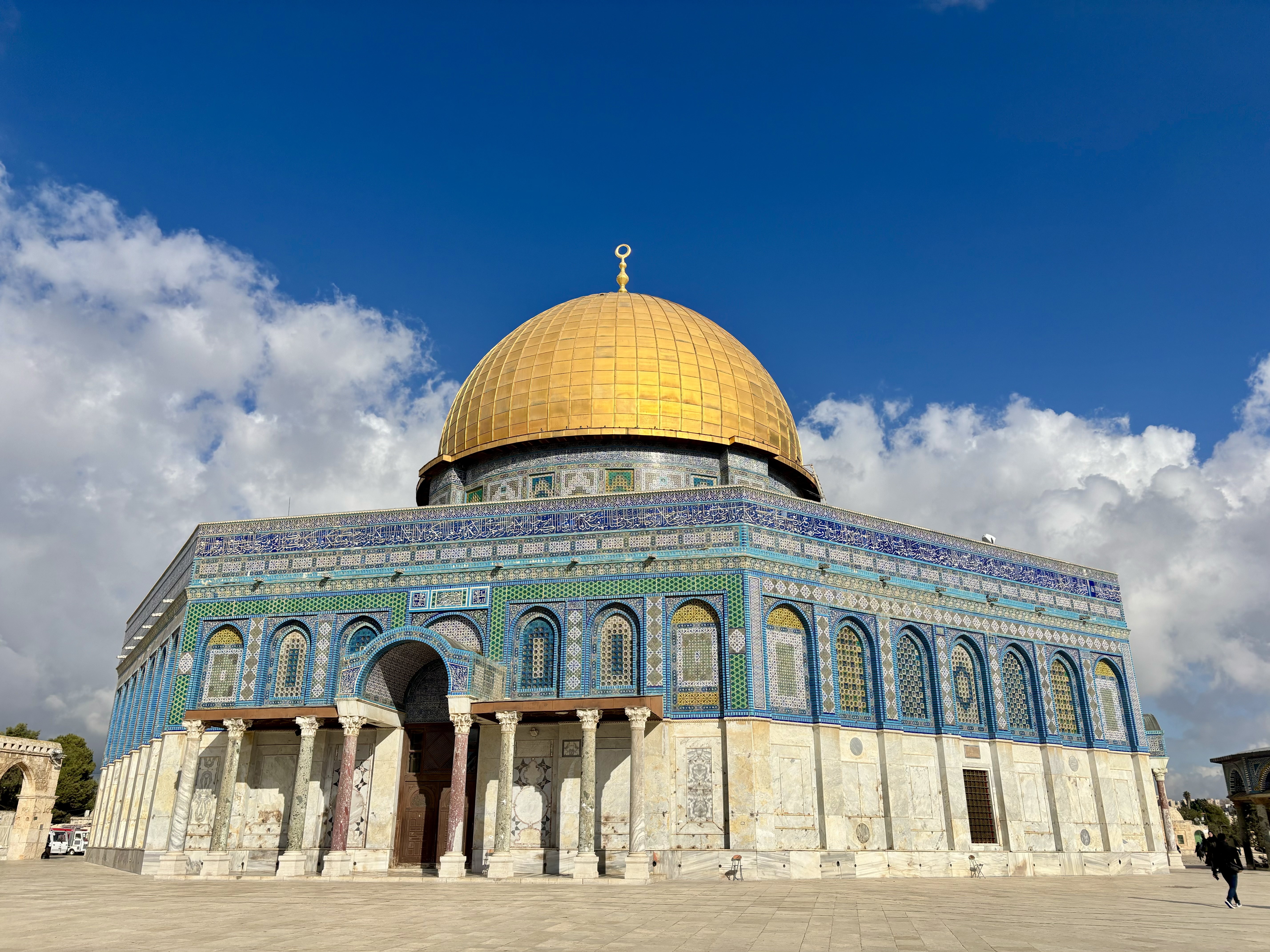
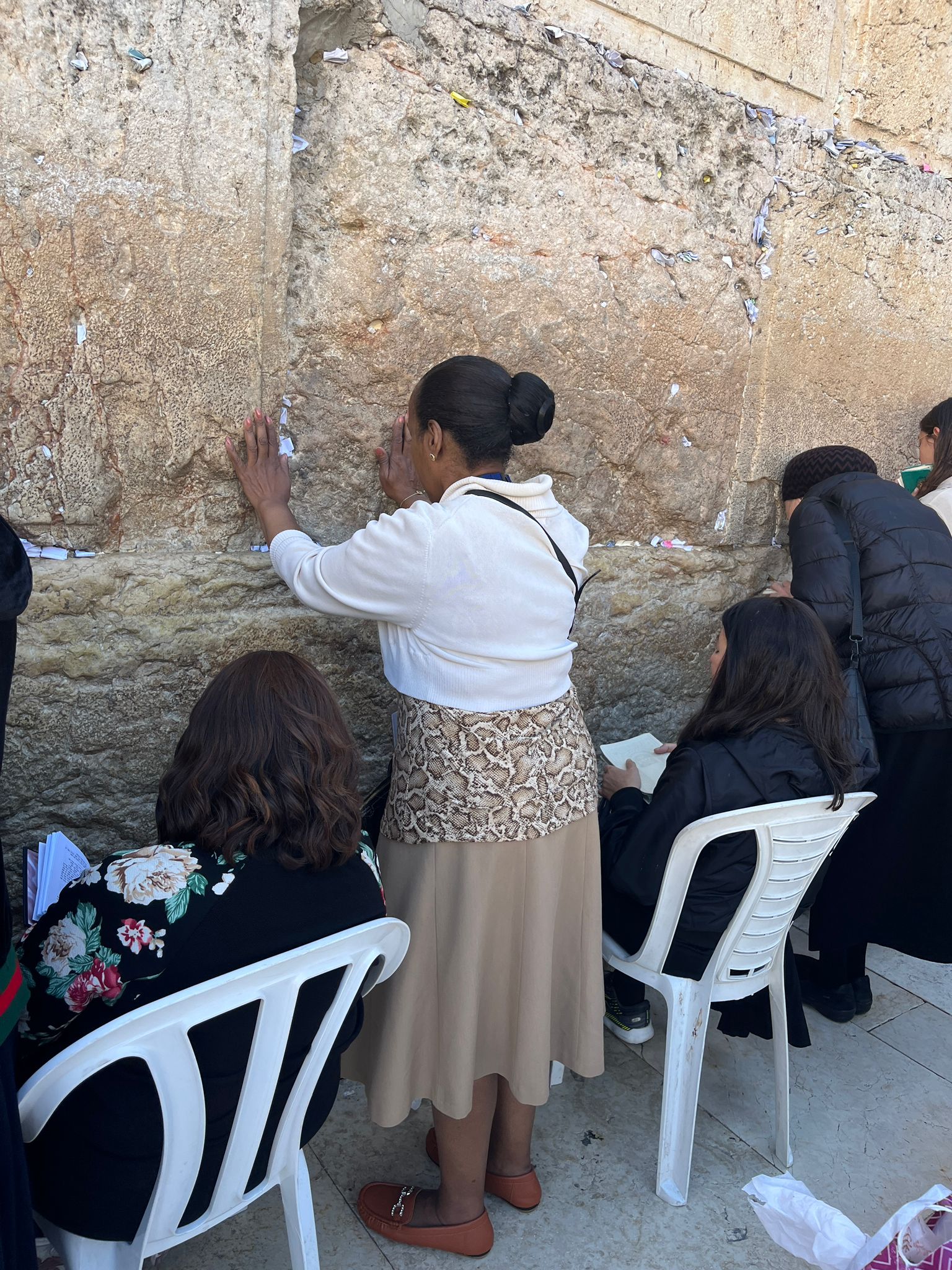
If so, The Temple Mount, with its Western Wall below—holiest shrine in Judaism—and Al Aqsa Mosque and Dome of the Rock above—holiest shrines in Israel for Muslims—is the “navel of Jerusalem.”
 
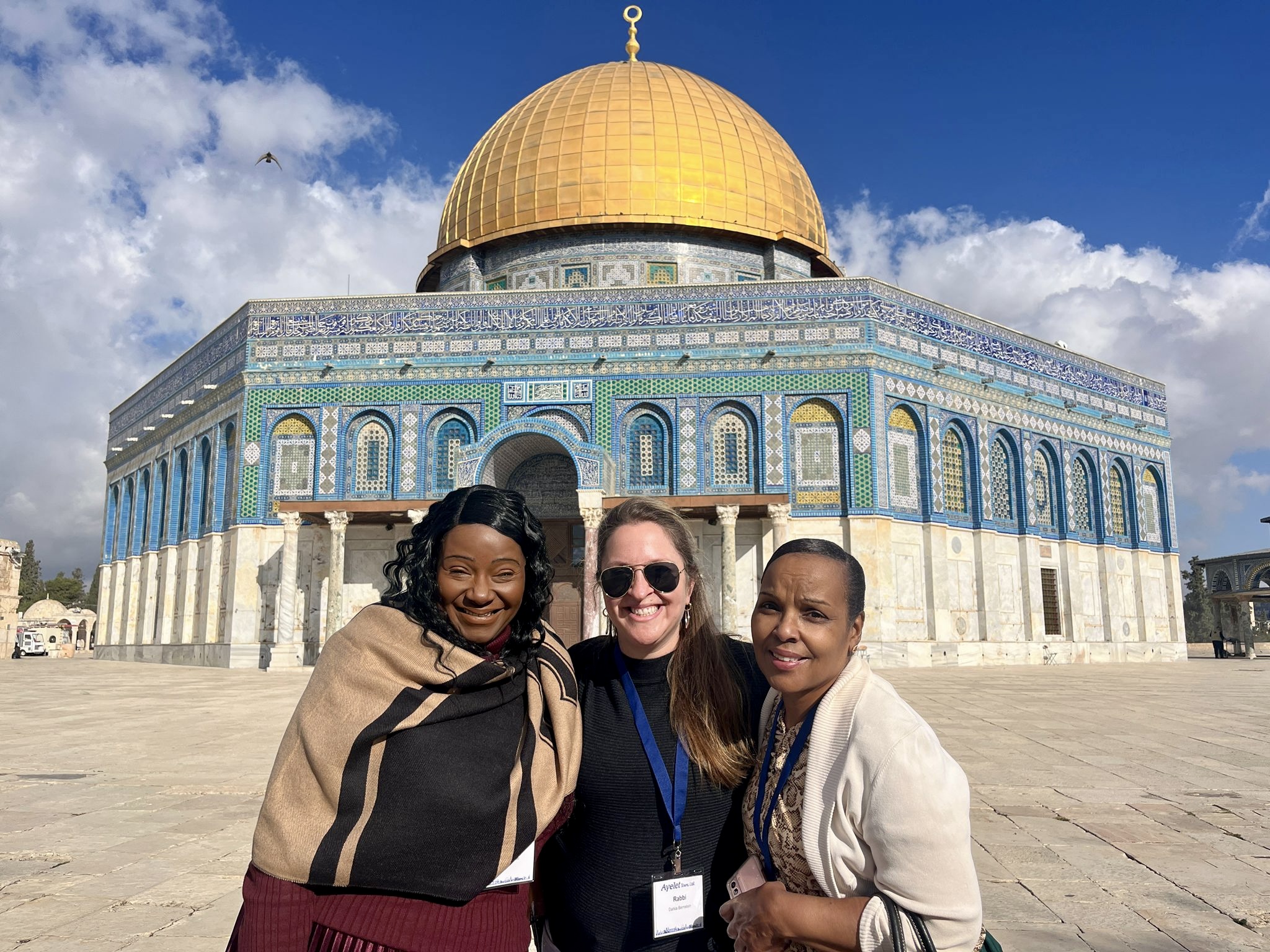
This morning our Westchester Jewish Council (WJC) Multi-Faith Clergy Delegation visited these holy sites—as tourists, but also as spiritual leaders who recognize that in today’s fractured world, there are still places that loom large and centrally in the imaginations of millions of people of faith, and which summon us to live for a noble purpose: to serve God and humankind. 

On this mount (Mount Moriah by name), Jewish tradition tells us Abraham bound his son Isaac. The passage can be found in this week’s Torah portion, Vayera (see Genesis Chapter 22). (Islamic tradition tells the same basic story but has Ibrahim (Abraham) nearly sacrificing Ismail (Ishmael).). I heard a Bar Mitzvah boy chanting this portion at the Kotel as I paused there to pray, followed by singing and dancing with his family on the nearby plaza. 

The same mythical location that inspires us to nobility, sacrificial service, and joyful observance of our traditions is also associated with acts of religious extremism and even violence. The holy site is often a flashpoint for religious tensions and provocations.
 
But this morning, Jerusalem is at peace, and we give thanks. May God continue to spread a shelter of peace over us, over Jerusalem, and over the hurting human family.

 
Tuesday, November 12th, 2024
11 Heshvan 5785

Dear WRT Family, 

Today our Westchester Jewish Council (WJC) multi-faith delegation spent part of the morning at the Max Rayne Yad b’Yad (Hand in Hand) Jerusalem School, one of six bilingual, bi-cultural schools (elementary through high school) in Israel where Jewish and Palestinian-Arab Israelis learn together in Hebrew-Arabic classes with paired Arab and Jewish teachers, dual holiday observances, and a unique curriculum designed to foster dialogue and listening between disparate cultures and lived realities. 

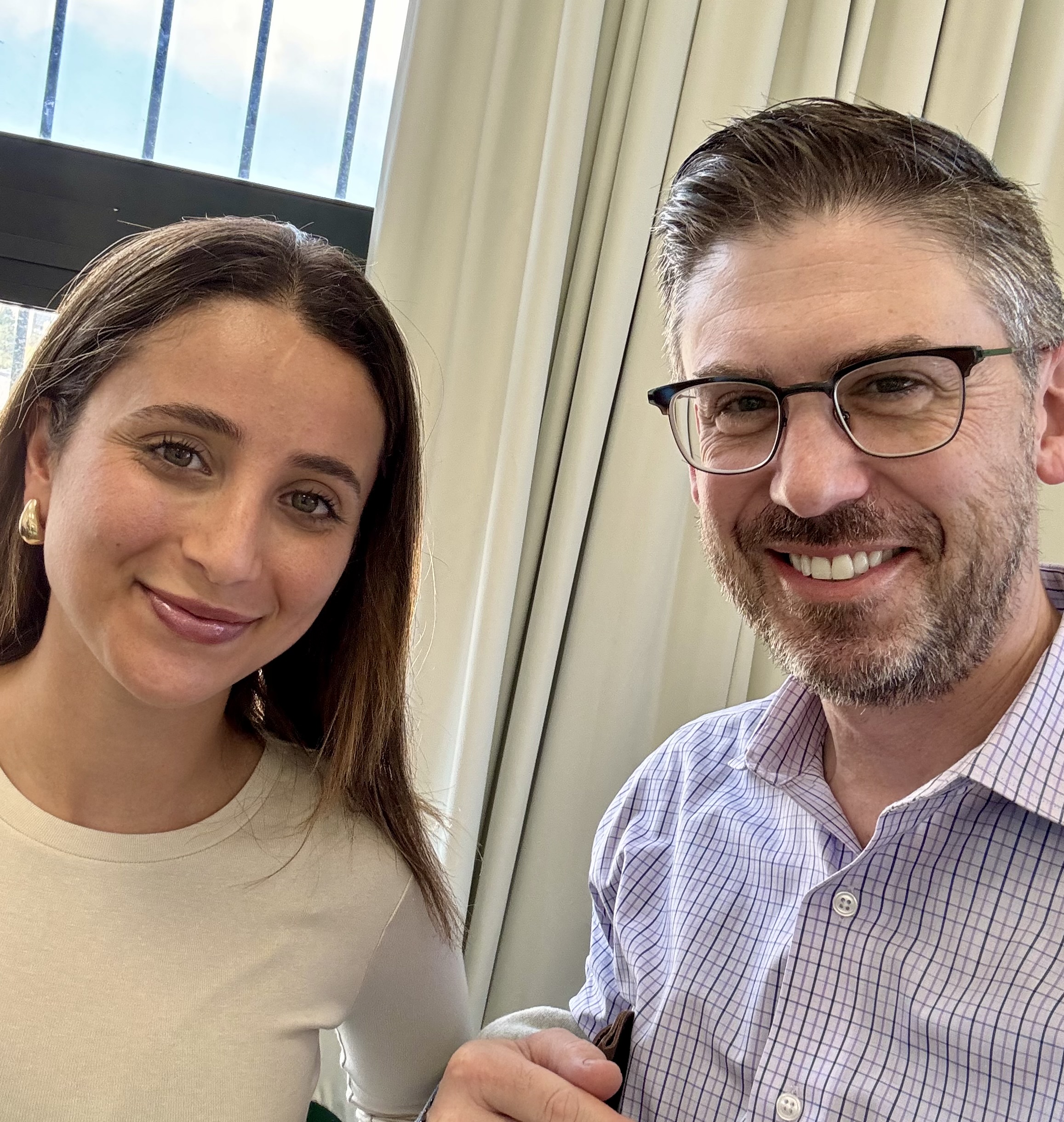
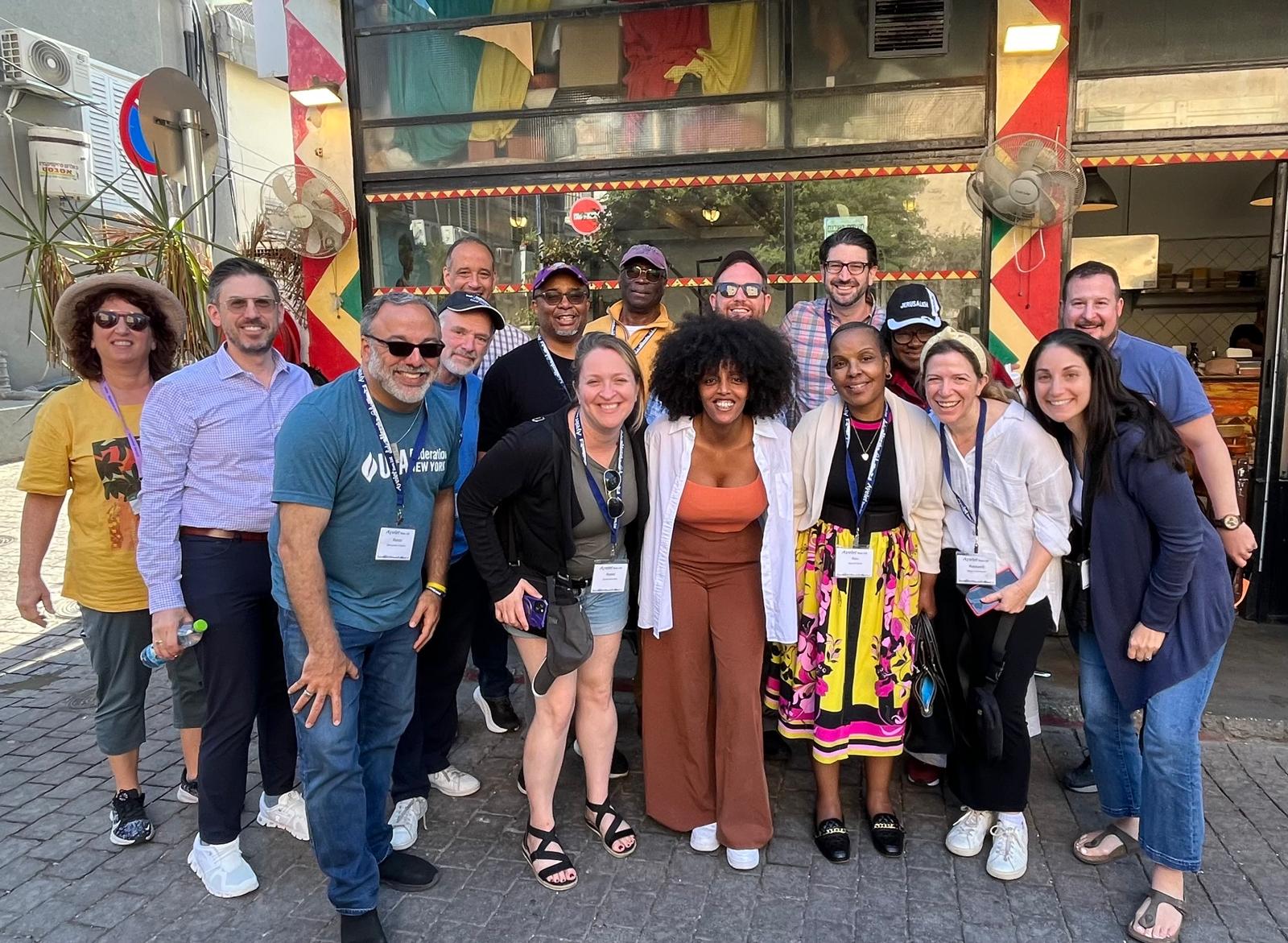
We met with Noor, who is a spokesperson for Yad b’Yad (pictured with our group, and with me), an Arab woman who grew up in Israel and who interacted with her first Jewish person at age 19. Asked about how the school, and especially the students, have responded to the horror of October 7th and the ensuing brutal war, Noor shared that the philosophy of Yad b’Yad is that through sustained, painful dialogue, what seems impossible can become possible. The hard work of building commonality across a chasm of difference begins with sharing personal and family stories and listening intentionally to another person’s pain.
 
Unfortunately, very few Israelis — Jewish or Arab — are exposed to this mixed-learning environment. The vast majority of Israelis attend separate schools for Jewish kids and Arab kids. And by high school, most of the Jewish kids transfer out, while Arab students remain at Yad b’Yad (largely because the quality of the academic program exceeds what is available to most Arab youth in Israel). 
Nevertheless, the families who began this bold project 26 years ago led from a vision of a different future for their children. As is written in this week’s Torah portion, “On the mountain of the Eternal, there is vision” (Genesis 22:14). They remind us that with vision, we can move from the way things are to the way they ought to be. Yad b’Yad offers a small glimmer of hope in the darkness. 

Wednesday, November 13th, 2024
12 Heshvan 5785

Dear WRT Family, 

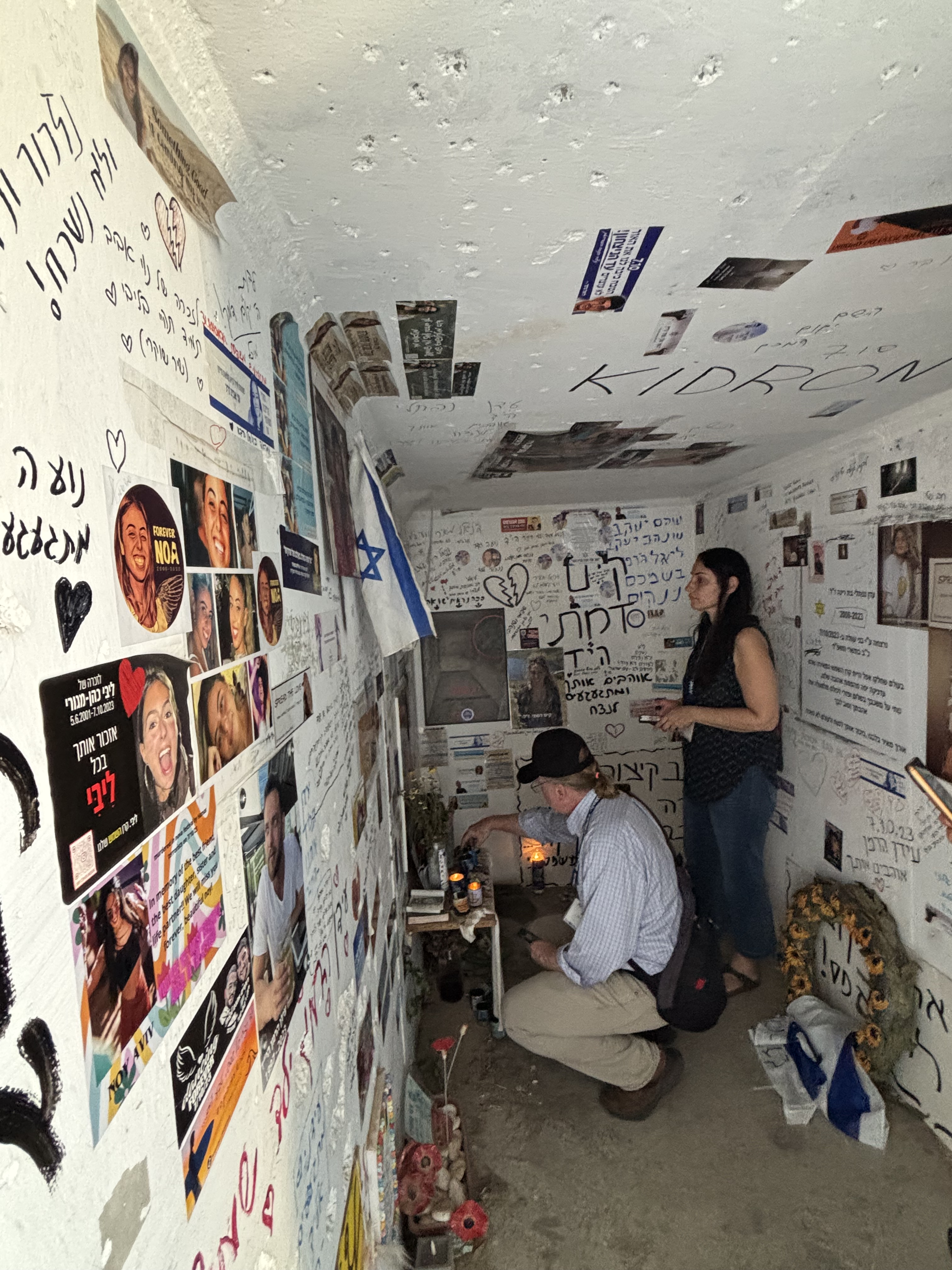
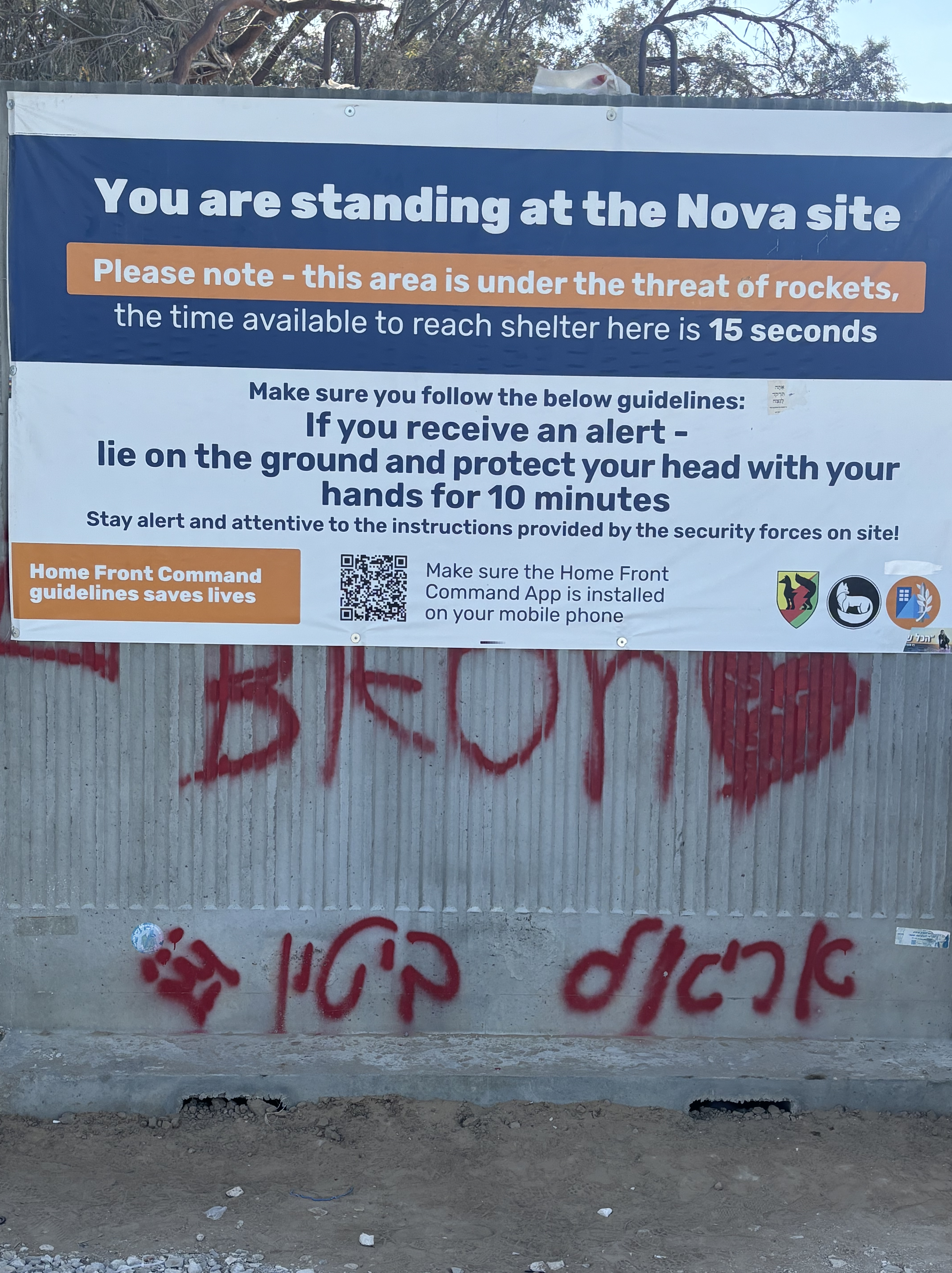
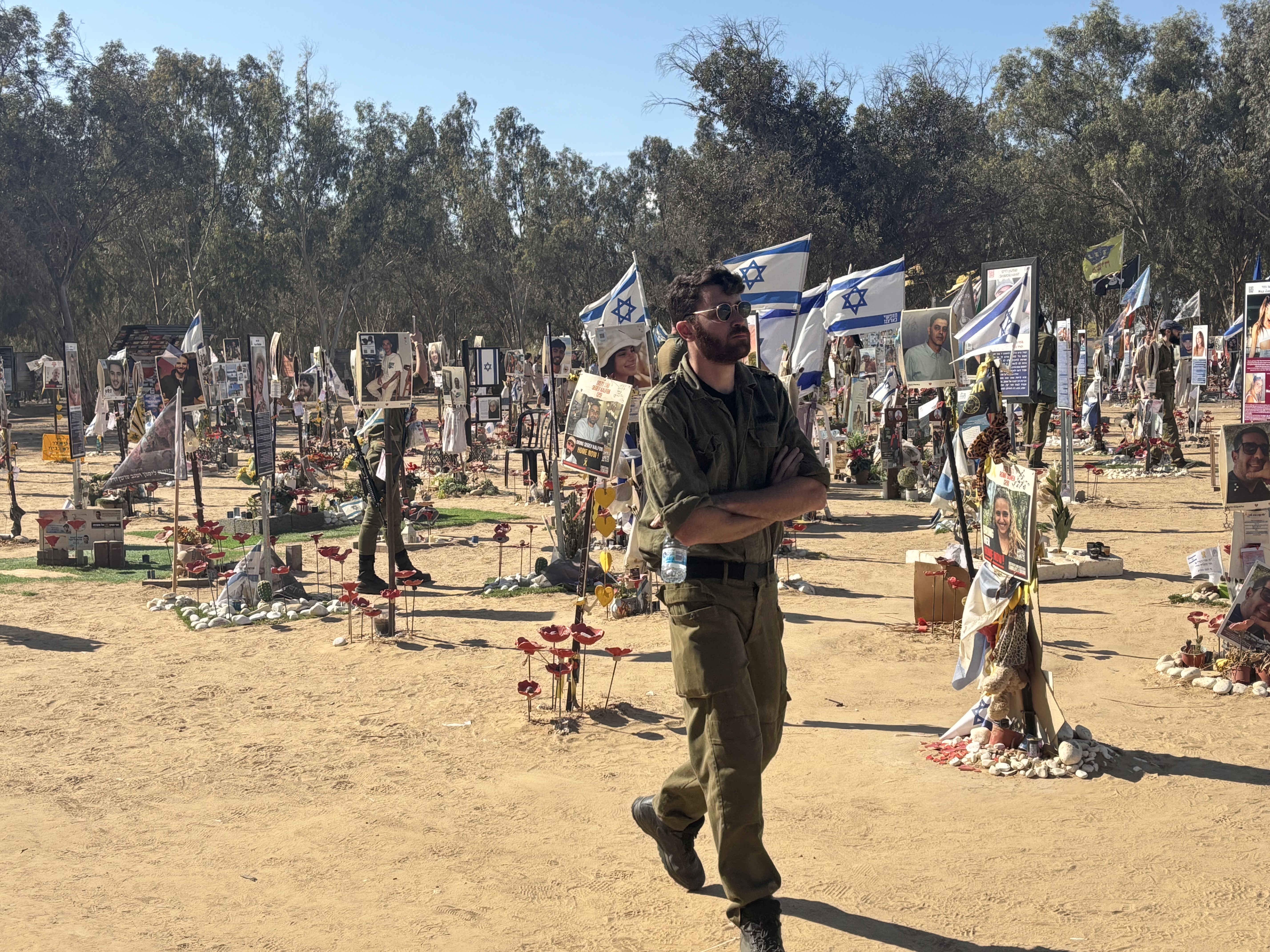
The Torah portion we are studying this week—Parashat Vayera (Genesis 18:1-22:24)—begins with Divine messengers visiting Abraham’s tent days after the covenantal circumcision of the males of his household. The Rabbis read into this passage the mitzvah of bikkur cholim, visiting the sick. It is a Jewish imperative to give comfort to the ailing, the wounded, and the bereaved. The Babylonian Talmud (Sotah 14) understands all of these compassionate behaviors as ways of emulating the Divine. That’s the best way I can make sense of our visit, this morning, to Ofakim and the Nova Festival site, two of the many targets of the Hamas massacre of October 7th. 

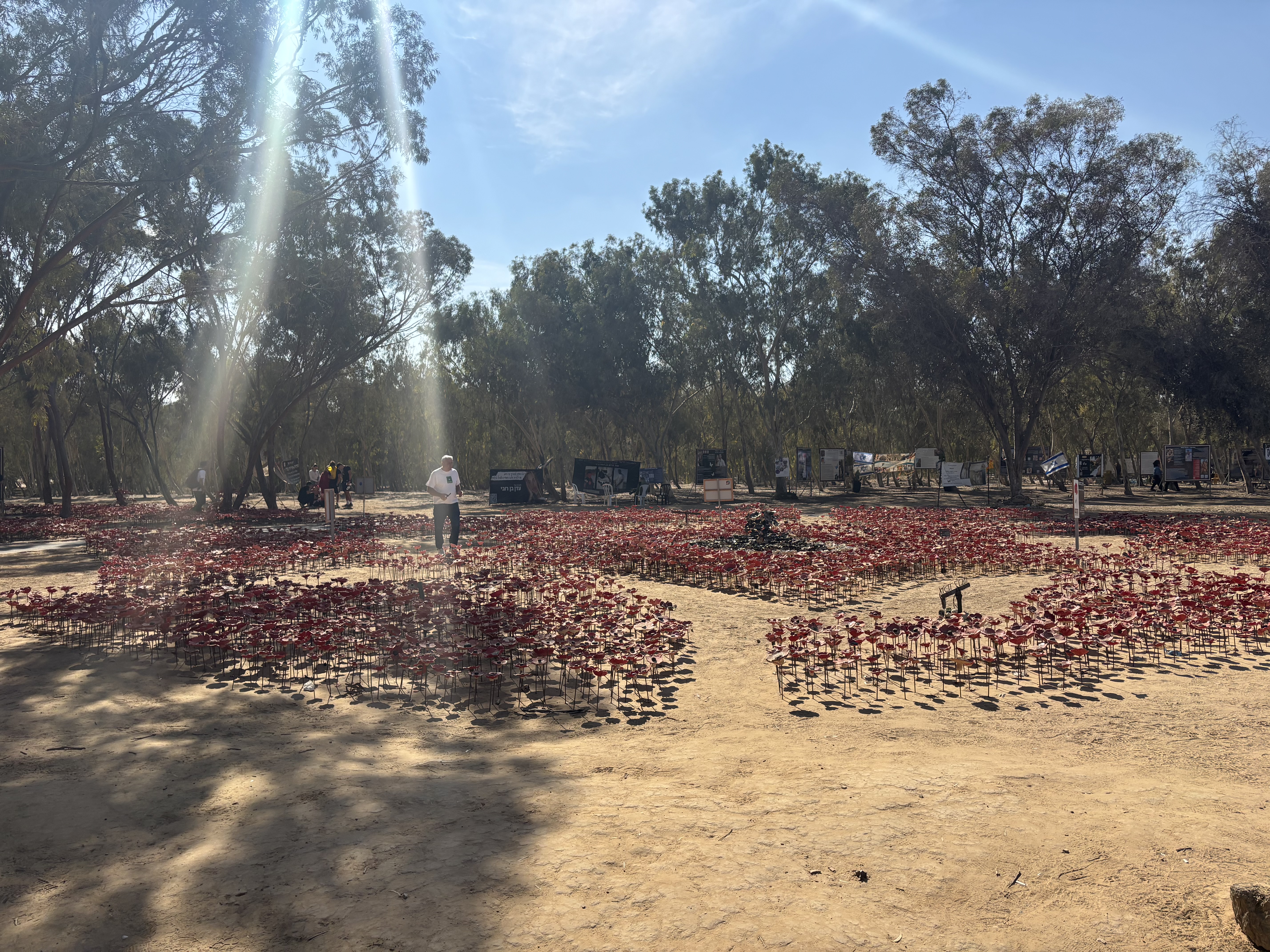
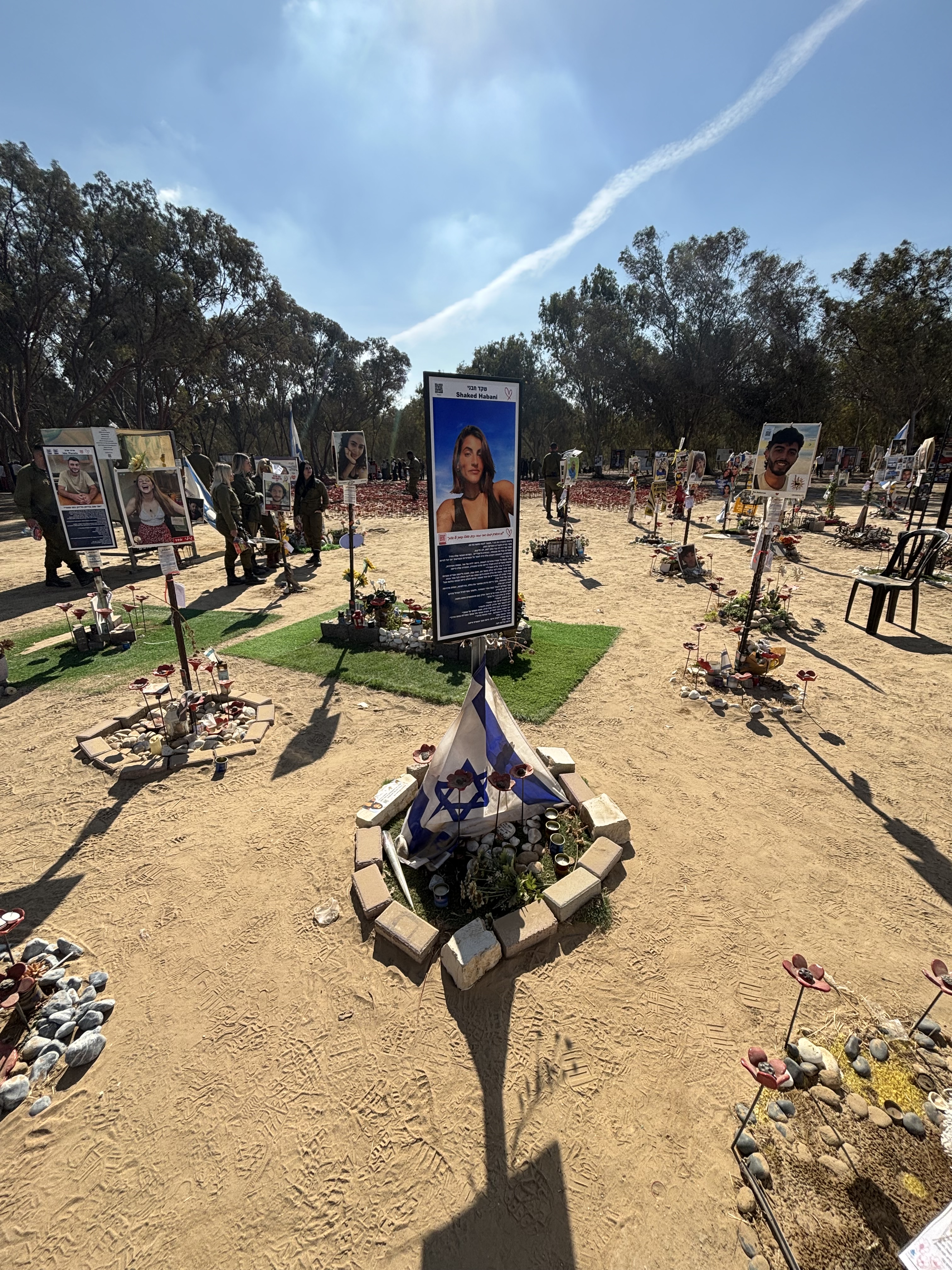
Ofakim, a sleepy city about 35 km from the Gaza border, lost more than 50 of its residents, and 364 individuals were murdered in cold blood at the Nova festival. Taken together, the victims of these two sites represent about 1/3 of the people slaughtered by Hamas on October 7th. It is hard to describe the feelings of numb rage and mute sorrow that accompanied our visit this morning. From what I could tell, we were the only American visitors to the site, a small cluster of pastors and rabbis who nodded silently to the many IDF soldiers there to pay their respects to their murdered friends, family, and fellow citizens.
 
What little comfort I found in making pilgrimage to what has become Israel’s “Ground Zero” of sacred remembrance came from the same Talmudic passage referenced above, which also observes that a person who visits someone who is ailing “takes away 1/60 of that person’s suffering.” “One sixtieth” is an idiomatic way of describing “the smallest measurable portion.”

It’s a passage I take seriously, if not literally. I have seen time and again how simply showing up for people in pain—whether through a hospital visit, or a shiva call, or, indeed, this trip to Israel—can alleviate a tiny bit of suffering. 

Just a little. 

The smallest measurable portion. 

May God comfort those who mourn and bring consolation to the broken-hearted. 


Thursday, November 14th, 2024
13 Heshvan 5785

Dear WRT Family, 

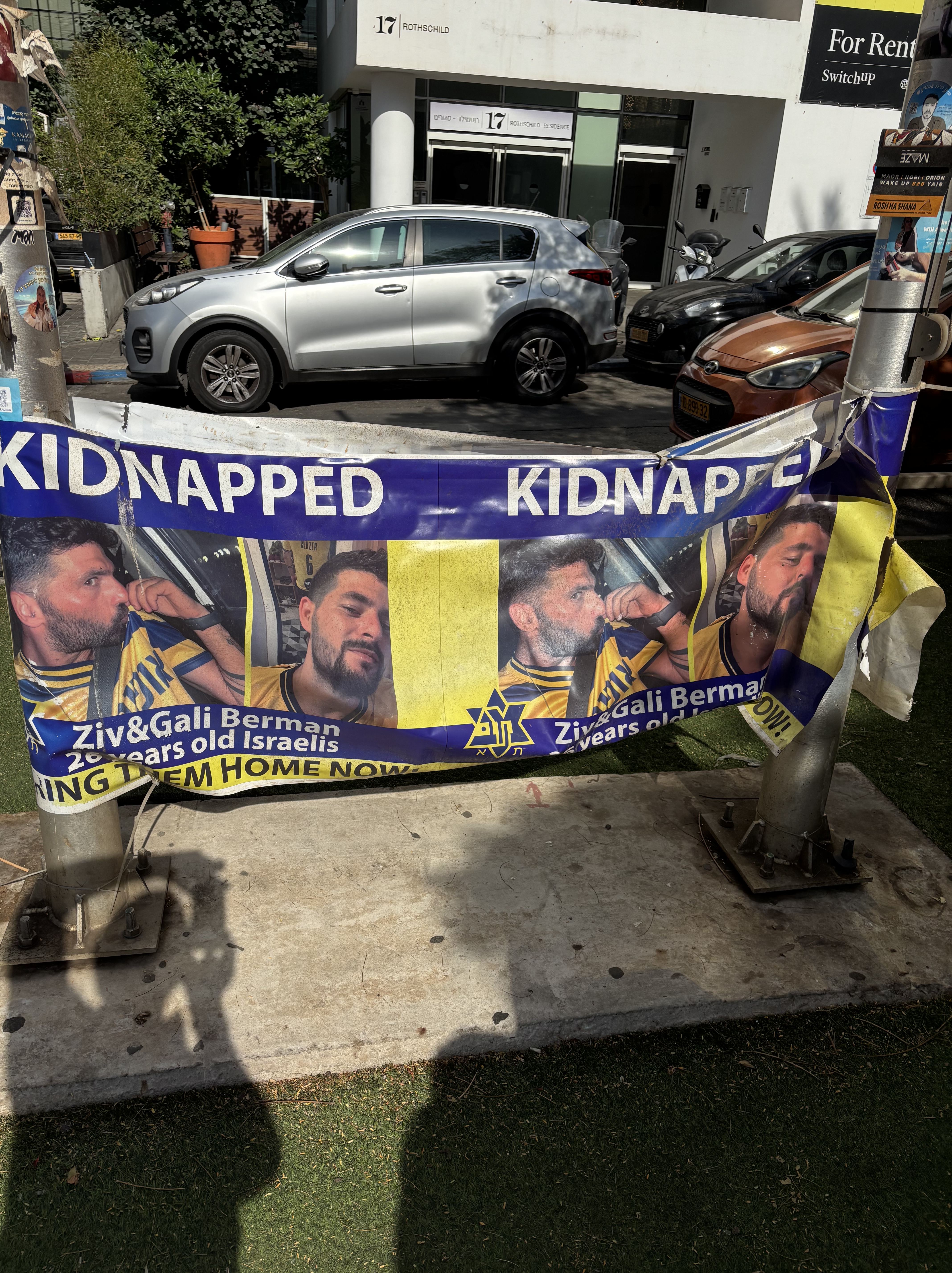
The faces of the hostages and the murdered stare back at you from every street corner and park bench in Tel Aviv. 

We’re here, in the cosmopolitan heart of Israel, for the last day of our mission, and the pictures I’ve included below were all taken within a 5-foot radius from Rothschild Boulevard, one of Tel Aviv’s main arteries and the home of Beit HaAtzma’ut, Independence Hall, where David Ben Gurion declared Israel’s independence in May 1948. That’s the squat building with the torn-up façade behind a spiderweb of scaffolding. It’s been “under construction” for several years now, but the sad truth is that the project has been mismanaged, has run out of money, and remains in limbo. Directly across the street from this monumentally significant building (in such a monumental state of disarray), the face of 25-year old Eden Yerushalmi (z”l) murdered in a tunnel beneath Gaza in August—whose body was recovered in the arms of fellow captive Hersh Polin (z”l)—implores the reader, Remember me, ok? 


I imagine the two are in dialogue with each other: the symbol of Israeli independence—battered and gutted but still standing—and the face of a murdered hostage, each imploring the other: Remember me, ok?

At the end of this week’s Torah portion, Vayera, God promises Abraham:

“I will bless you, making your descendants as numerous as the stars of the heavens and the sand upon the shore of the sea, and your descendants shall seize the gates of their foes” (Genesis 22:17). 
That promise—like our unfinished Beit HaAtzma’ut, House of Independence—is still a work in progress, still being built (and rebuilt), with great struggle and sacrifice.
 
But here, even now, Am Yisrael Chai: the people of Israel lives. 
Rabbi Jonathan E. Blake 

Rosh HaShanah 5785: A Letter to our Anti-Zionists

Dear Anti-Zionist Jews:

It has taken me a year to write this letter. I’ve agonized over what to say, not finding the words.  I needed to write this letter to clear my head. To clarify my thoughts.  Maybe it will also open a dialogue between us.  I hope it will.

With so much dividing us these days, we also share an overriding commonality.  We are Jews, which means we are family, just 15.8 million, a sliver of a sliver of humanity.  No matter how sharply we may disagree, we cannot disown each other.  

We Jews need to stick together.  Family should not demonize their own.  You have been maligned. You feel misunderstood.  You are wondering where you fit within the Jewish community these days. 

The Haggadah speaks of a child called rasha.  Usually translated “wicked,” the rasha in fact refers to one who chooses to stand outside the Jewish community, asking, “What does this ceremony mean to you?  The rasha challenges accepted Jewish norms.  The Haggadah goes on to rebuke the rasha’s perspective, but never excommunicates that child from the community.  

We share a common language of Jewish values.  You’ve expressed that your anti-Zionism emerges from your understanding of Tikkun Olam, the directive to repair a broken world.  You’ve reminded us that Judaism abhors the shedding of blood.  Images of broken bodies and broken families and broken buildings clash with Judaism’s emphasis on love of neighbor and compassion for the vulnerable.  You insist “Never Again” is a universal imperative, one that applies not only to the Jews. This is very Jewish. 

You also assert that Judaism can thrive without Zionism, that Jews do not need a state of our own, that Diaspora gives us everything we need.  It’s easy to make that statement from the relative comfort and safety of America.  The half of our family that lives in Israel, about 7.5 million of us, the vast majority descended from refugees whose only hope could be found in the Jewish State, begs to differ.

We are Jews, each deserving a place at the family table of the Jewish People.  At the same time, I feel terrible angst about anti-Zionism entering the Jewish mainstream.

In order to help you understand why, here’s my story. 

It begins well before most students on today’s college campuses were born, almost thirty years ago, when I first set foot in Israel, in June of 1995.  All Reform Jewish clergy spend a year immersing ourselves in the culture, history, language, and land of Israel.  

I arrived believing, like many at the time, that peace between Israelis and Palestinians was around the corner.  Two years earlier, Prime Minister Yitzhak Rabin shook hands with PLO leader Yasir Arafat on the White House lawn, with President Bill Clinton between them, nudging them closer than either preferred.  What made this possible was something called the Oslo Process, a series of bilateral negotiations between Israel and the Palestinians, designed to achieve peace and pave the way for the establishment of an independent Palestinian state.

This was neither fantasy nor love-fest.  It may seem hard to believe today, but at the time, a majority of Israelis, Palestinians, and Jewish Americans supported the peace process.  A two-state solution had emerged as the only just conclusion to decades of hatred, mistrust, and violence.  

It was never intended to inaugurate a warm and loving marriage, but rather to effectuate a “divorce,” if you will, ending a resentful entanglement between estranged partners who nevertheless had concluded that both had legitimate claims to the same small strip of land.

As Rabin memorably wrote after that fateful handshake:  “We don’t make peace with friends.  We make it with enemies.”  

That Palestinians and Israelis remained enemies even throughout the Oslo Process became apparent as I got ready to move to Israel.  Jewish extremists and Islamic fundamentalists used horrifying violence to sow panic and mistrust.  

At the time, mass shootings and suicide bombings were not the stuff of everyday headlines.  These were game-changing attacks, carried out by fanatical Zionists and anti-Zionists, who, ironically, shared a common goal: disrupt and destroy the peace process by any means possible.  Apocalyptic religious visions seduced extremists on both sides to choose hate over love, war over peace, conquest over compromise. 

And yet, as I arrived in Israel in the summer of 1995, the peace process moved forward:  hobbled, but not incapacitated.  

Saturday night, November 4th, I had returned to my apartment after an evening spent playing trivia games and drinking beer with some friends, when the phone rang.  A classmate.  “Turn on the radio,” she said.  “Rabin’s been shot.”  We had classmates at the peace rally in Tel Aviv where the Prime Minister had been speaking to a crowd more than 100,000 strong.  Rabin himself had expressed astonishment at how many Israelis had shown up to support peace with the Palestinians.

Israel’s most idealistic youth turned out in force.  People, it seems to me, a lot like you:  Jews determined not to accept the status quo, willing to be the rasha at the Seder table.  Jews, mostly young, who recognized in Israel’s Palestinian neighbors the faces of suffering human beings.  Jews who detested the fact that, more than a quarter-century after the Six-Day War, the West Bank and Gaza still remained under Israeli control (this being ten years before Israel unilaterally withdrew from Gaza), with Palestinian mobility, freedom, dignity, and aspirations thwarted.  Jews, full of passion and compassion.  Again, a lot like you.

In 1995–unlike today—it was not unusual to identify as both pro-Israel and pro-Palestinian, wanting the same thing for both: a safe home to call their own.  

That’s why those idealistic youth showed up that electric November night, jumping with their pro-peace banners into the plaza’s fountains with unbridled joy while Rabin sang along to Shir La-Shalom, the beloved “Song for Peace,” as the rally was wrapping up.

At that moment, a 25-year old Jewish law student and religious extremist named Yigal Amir quietly stepped out of the crowd and put two bullets in the back of the Prime Minister at near point-blank range.  Rabin was declared dead an hour and a half later.

In hindsight, many of our hopes and dreams died that night as well.  If you had been there, I believe yours would have, too.      

The next day, numb with shock and grief, I found myself standing in line with hundreds of thousands of Israelis, to honor our fallen hero.  I shuffled by his casket as it lay-in-state on the plaza of the Knesset.  I watched his funeral procession from my apartment balcony and could pick out President Clinton’s motorcade.  I remember Rabin’s family members stumbling through the words of the Mourner’s Kaddish.  But the image I will never shake is of a silent man, sitting cross-legged in Jerusalem’s Zion Square, a sign around his neck with one Hebrew word written in blood-red paint:  בושה.  SHAME.     

The rest of my year in Israel went by like a restless night, all of us trying to keep things as normal as possible:  field trips to explore Israelite archaeology; Biblical grammar quizzes; tutoring a 12-year old Jewish Ethiopian immigrant boy whose Hebrew was as rudimentary as mine; singing Reform Jewish camp songs with my classmates Friday mornings on Ben Yehuda Street, Jerusalem’s pedestrian mall; navigating the sensory assault of the shuk (the outdoor market); figuring out how to argue like an Israeli when someone cut me off in a supermarket checkout line or when the laundromat lost every other sock I owned, only to be rebuffed that “you Americans don’t understand the pressure we Israelis live with every day.”  

On February 25th and March 3rd, 1996, loud explosions startled me from a sound sleep.  Within two miles of my apartment, Hamas suicide bombers had carried out twin bombings on Jerusalem public buses, one week apart, murdering 45 people.  A rash of similar attacks followed in swift succession, every couple of weeks or so throughout the winter and spring: on buses, residential streets, near the popular Dizengoff Center in Tel Aviv.  The victims included a number of young American students.  I have to be honest – I was scared.  Sad.  Angry.  And so, so homesick.

We rode out the rest of the school year in an uneasy mixture of dread and hope, bound by the commitment that, as Jewish leaders-in-formation, we were all in this together.  None of us left Israel.  Most of us stopped riding the buses.  Many of us leaned into activism, animated by a belief, however naïve it may seem today, that the voices of moderation would prevail, that the momentum toward a just solution to the conflict would override the voices of religious extremism and uncompromising nationalism:  ideologies that make no room for the other, that view the world in binaries: black and white, good and evil, my team or no team.  

The school year ended. Following Rabin’s assassination, Israeli society had fractured over the best way forward.  Rabin’s heir apparent, veteran statesman Shimon Peres, pledged to revive the peace process and proceed with Oslo.  His opponent, a charismatic 47-year old, promised to be tough on terrorism and hard-nosed with Arafat.  Until the day of the election it looked like it could go either way.  

On May 31st, 1996–the day I arrived back in the US–Benjamin Netanyahu was elected Israel’s next Prime Minister.

There is so much more I could tell you about the last thirty years.  As my Zionism has grown and deepened, so has my appreciation for the complexity with which Israelis live; how, for them, the world’s only Jewish State holds the keys to their past, present and future; how they will willingly lay down their lives and send their children into harm’s way to protect the only place in the world that protected them and their families when the rest of the world showed them the door, forced their conversion, stole their property, and murdered them; how, when their government fails them, they take to the streets to demand better; how, when the global Jewish community fails them, they feel grievously betrayed, because it is their own family turning their backs on them. 

I have also seen how the status quo has failed the Palestinians.  I have been to the border of Gaza and inside the West Bank–many times.  I have been to the checkpoints where Palestinian laborers idle in interminable lines, carrying their lunches in see-through plastic bags so as not to arouse suspicion, subjected at times to humiliating inspections, all in order to earn a living wage—because the best-paying jobs are to be found in Israel, not in the territories.  

I have seen peace offers come and go, some more promising than others, the best of them rejected by Palestinian leadership; opportunities to re-engage ignored by hardline Israeli governments who apparently have little regard for what Rabin said about making peace with your enemies, not your friends.  

I have seen years of terror and years of quiet–quiet enough, at times, to lull us into a false sense of security that the conflict had evaporated (a complacency shattered on October 7th).  

Since my year in Jerusalem, a new generation of Israelis and Palestinians has grown up behind fences and walls, erected to save Israeli lives, which, thank God, they have and still do.  

But a byproduct of these barriers is that, for twenty years, Palestinians and Israelis have inhabited separate and dissimilar realities, growing up with their own mythologies and prejudices about the other, untempered by human interaction. 

Israel has become an economic and technological powerhouse. Palestinians have languished in squalor, victims at least as much of their own autocratic, cynical, and feckless leaders as they are of Israeli repression.  And Hamas persists, unwavering to the end in its jihadist ideology, unbending in its determination to “liberate” Islamic lands from the Jew.  

You rightly point to the ugly inequality of Jews and Palestinians living in the West Bank.  Just know that when Hamas talks about “ending the occupation,” they don’t mean IDF-controlled West Bank highways, enclaves, and checkpoints, unchecked Jewish settler violence, or encroachment on Palestinian farms and olive groves; they don’t even mean the blockade of Gaza’s borders which Israel administers jointly with Egypt.

No.  For Hamas, Tel Aviv is “occupied.”  Haifa is “occupied.”  Eilat is “occupied.”  Hamas, like its ideological confederates in Hezbollah, ISIS, Al Qaeda, the Islamic Regime in Iran, the Houthis, and like-minded movements across the globe, envisions a world that is Judenrein, the word the Nazis used to mean purged of Jews.  Theirs is a zero-sum game. 

One cannot understand October 7th or what has followed without first understanding that Hamas has spent the last seventeen years putting every last dollar that could have been used to care for the people of Gaza into building a vast apparatus for asymmetrical warfare:  training tens of thousands of fighters in land-, air-, sea-, and cyber-combat; building a massive, impenetrable fortress beneath Gaza; using its civilians as human shields; all while brainwashing Gaza’s children to become martyrs devoted to the cause of eliminating Israel.  

I don’t blame you for not understanding this.  It is incomprehensible that a people can be so filled with hate, so committed to another people’s utter destruction, so callous about human life—in fact not seeing Jewish lives–our lives, yours and mine–as human at all.  It is difficult for our liberal Western sensibilities to comprehend.  The savagery of October 7th–the butchery, the torture, the rapes, the kidnappings, the grotesque glee expressed by perpetrator and spectator alike–is not incidental to Hamas’s aims.  It is part and parcel of a decades-long program to render co-existence with Jews and the Jewish State impossible.  

And, truth be told, the Israeli enemies of peace, whose malign intentions became clear following the Rabin murder, have not gone away, either.  A number of them now exercise outsize influence on Israel’s political agenda–including from their seats in the government–fomenting bitter infighting in Israeli society. 

You are not wrong to protest the suffering of the Palestinian people.  You are not wrong to protest the Israeli government, or the way it prosecutes war.  Critiquing Israel does not make one a Jewish traitor.  Israelis themselves are quite good at it.  Israeli democracy tolerates an extraordinary degree of dissent and it could be argued that argument is the national pastime.  

But I write this letter to implore you to manifest your compassion for the Palestinian people in ways that do not erase the reality of the other half of your Jewish family.  For every one of us, remember that another Jew is marking Rosh Ha-Shanah in Israel today.  Your mirror image.  Your twin.  

Back in 2007, the year Hamas violently seized power in Gaza, my Rabbi, Jan Katzew, wrote words that resonate with even greater force today.

“We live in an either/or world,” he observed. 

“Either you are for us or against us.  Either you are right or you are wrong.  Either you are good or you are evil….  Either you win or you lose.…  It may be simple to live in an either/or world….  An either/or world is inhabited by two types of people, friends or enemies, citizens or barbarians, members or infidels, brothers or others, people who have the truth and people who do not. In extreme cases, an either/or world is divided between people I would die for or people I would kill, people of God and people without God. We are all witnesses to an either/or world, but we do not have to accept it and live according to its norms.”

Judaism offers a different precept, known in the Talmud as “eilu va-eilu.”  The phrase comes from a famous debate between the rival teachers Hillel and Shammai, which had become so intractable that it had to be resolved by a Divine proclamation:  “Eilu va-eilu divrei Elohim chayim,” meaning, “These [opinions] and those [opinions] are both the word of the living God…  even though the law follows Hillel” (Eiruvin 13b).  

Our tradition rejects “either/or” and embraces “both/and.”  

The enemies of shalom live in an either-or world.  They say you must choose:  you cannot be both a Zionist and a champion of equality and justice for all God’s children.  They say that this little strip of land is big enough for only one people, “mine” or “yours,” not both.  

Eilu va-eilu:  there is another way.  You can critique Israel without making common cause with those who seek Israel’s destruction.  You can support Palestinian lives without denying Israeli lives.  You can be a Zionist without being a messianic triumphalist.  

Eliu va-eilu:  we need to accept once and for all that there is no reasonable or just outcome to this awful conflict where one nation emerges victorious and the other vanishes into thin air, or where one lives forever hunted and haunted by the other. 

Eilu va-eilu; both must live.  That can happen only when Palestinians turn from a vision of Israel’s destruction and choose to build a future alongside the sovereign state of the Jewish People. It can happen only when Jewish religious and national extremism and anti-Arab racism are seen as betrayals of our values and dead ends for Israel’s future.  It can happen only when the champions of both/and prevail over the patrons of either/or.

So I close my letter to you with a plea:

Come out of the makeshift tents on campus, and back to the big tent of Jewish communal life.

Stop canceling speakers who affirm Israel’s right to exist, and instead engage in dialogue and debate.

Please!  Get off of social media and participate in face-to-face conversation.

Step away from the fringes, the easy comfort of slogans and moral certitude.  Come rejoin the messy middle:  the place with no easy answers, but where compromise and connection are, God willing, still possible. 

It’s the first day of a new year.  

And our family table has a place set for you.    

I remain, yours,

A proud, pained, and ever-hopeful Zionist

Shanah Tovah.

“War! What Is It Good For?”: Sermon for Shabbat Bemidbar, 5784

At the height of the Vietnam War, American radio stations were blasting Edwin Starr’s “War”:  “War!  What is it good for?  Absolutely nothing!”

A blistering cover of the original recorded by the Temptations a year earlier, “War” became a runaway hit, holding the number one spot on the Billboard charts for three weeks in the summer of 1970.

“Say it again: War! What is it good for?” 

We ask, as we mark eight months of war.  

We ask on behalf of our hostages.

We ask on behalf of the Israeli people, still reeling from the physical, sexual, and emotional violence inflicted on October 7th.  

We ask for the sleepless Israeli parents with children serving in Gaza, in the North, in the West Bank, in all the places we tourists dare not go.  

We ask for the more than 100,000 Israelis still displaced from their homes, for the residents of the northern towns burned by incendiary rockets fired by Hezbollah just this week.  

We ask for the Palestinian civilians in Gaza killed and maimed and displaced from their homes, for the hungry and the thirsty, the sick and the frightened, whom Hamas has victimized by making them human shields, by stealing their food and water and medicine and fuel, and, worse: their hope.

We ask for the Jewish students for whom this war has become an inescapable fact and feature of collegiate life, abused with hate speech, accused of genocide.  Kids who just want to hang out with their friends and drink beer and even attend classes or study in the library free from harassment.  

We ask alongside the growing number of Israelis who are tired of this war, sick and tired of politicians whom they do not trust to prosecute this war.  We ask alongside the tens of thousands of Israelis who protest every week, begging their government to shift focus from bombarding Rafah to bringing hostages home.  

“War! What is it good for?”  

This is a reasonable question to ask, eight months into a terrible war.  

It is, however, a difficult question to answer.  

We turn to the Jewish tradition.  Our prayer book is a love song to peace.  Oseh shalom bimromav—“May the One who makes Peace in the heavens bring peace upon us”; Shalom rav al Yisrael am’cha—“May a great peace come upon Your people Israel”; Sim shalom, tovah u’vracha—“Grant peace and goodness and blessing….”  

If the Siddur were all we had, you’d probably conclude there is no place for war in the Jewish tradition.  But the Torah, TaNaKh, Mishnah, Talmud, and Midrash, the collections of Rabbinic teaching and storytelling, the annals of Jewish history and codes of Jewish law, all make clear that war is not only sometimes permissible, but even, sometimes, imperative.  

The Torah itself provides conditions for going to war and the rules governing military conscription, exemption, and ethical conduct in war.  This week’s Torah portion, Bemidbar, opens the Book of Numbers with a census of the Israelites, mustering them tribe by tribe in the Sinai Desert for a planned invasion of the Promised Land.  Military conscription, at least for the men, was part and parcel of being numbered among the Israelite ranks.

שְׂא֗וּ אֶת־רֹאשׁ֙ כׇּל־עֲדַ֣ת בְּנֵֽי־יִשְׂרָאֵ֔ל לְמִשְׁפְּחֹתָ֖ם לְבֵ֣ית אֲבֹתָ֑ם בְּמִסְפַּ֣ר שֵׁמ֔וֹת כׇּל־זָכָ֖ר לְגֻלְגְּלֹתָֽם׃

Take a census of the whole Israelite company [of fighters] by the clans of its ancestral houses, listing the names, every male, head by head.

מִבֶּ֨ן עֶשְׂרִ֤ים שָׁנָה֙ וָמַ֔עְלָה כׇּל־יֹצֵ֥א צָבָ֖א בְּיִשְׂרָאֵ֑ל תִּפְקְד֥וּ אֹתָ֛ם לְצִבְאֹתָ֖ם אַתָּ֥ה וְאַהֲרֹֽן׃

You and Aaron shall record them by their groups, from the age of twenty years up, all those in Israel who are able to bear arms (Num. 1:1-2).

The Book of Numbers describes how, over the course of their wilderness journey, a debilitated band of escaped slaves will be rehabilitated as a fighting force to be feared by Israel’s enemies.  It leads to Deuteronomy, in which Moses readies the troops for combat, straight on to the Book of Joshua, a logbook of the military campaign against the Canaanites.1

Wars are, of course, fought for numerous reasons, among them economic, political, and territorial; wars are fought over ideology and religion, and, even, sometimes, out of revenge.  

Judaism designates two primary categories of war:  Milhemet Reshut, or Discretionary War, in other words, a war that you may fight; and Milhemet Mitzvah, or Commanded War, a war that you must fight.  (Literally, a war that is a mitzvah to fight.)   

RaSHI and Maimonides, each writing in the 12th Century, defined Milhemet Mitzvah as a defensive war that one fights only in response to an already-launched attack. (Cf. RaSHI to Bavli, Sotah 44b, and Maimonides, Mishneh Torah, Hilkhot Melakhim 5:1).     

The Sages are divided over how to categorize wartime operations designed to prevent an enemy from attacking.  The Meiri, writing in France in the 13th century, concludes that “one can launch a preemptive strike against an enemy amassing forces on a border,” which he considers “sufficiently defensive to be categorized as a Milhemet Mitzvah,” a war of obligation (Commentary to Sotah 44b). 

In sum, the more a war can be seen as defensive, the more likely Jewish tradition will classify it as obligatory; the more offensive or expansionist, the more likely to be classified as discretionary.  

At no time does Judaism give permission to conduct war wantonly, without regard for civilian life, not in the traditional literature, nor in the ethical code of the IDF known as Tohar Ha-Neshek or “Purity of Arms.”  

But principle and practice are not the same thing and in the chaos of war, bright lines blur; decisions are made without good intelligence; and terrible suffering is inevitably inflicted on non-combatants.  

This is a grievous fact of war, but it is neither unusual nor even necessarily immoral.  War is not a war crime. The morality of war is not measured in the proportionality of body count between one belligerent and another, but rather in the proportionality of the effectiveness of wartime measures taken, against the identified military objectives.  

The Allied invasion of Normandy on June 6th, 1944–eighty years ago yesterday—resulted in somewhere between 4,400 and 10,000 Allied casualties and an estimated 4,000 to 9,000 German casualties.  But no one evaluates the merit, or morality, of that invasion this way.  How many Allied lives were worth sacrificing in order to defeat the Nazis?  How many German lives?  These questions are strictly rhetorical.  

What to do about the War in Gaza?  This is not a rhetorical question.  It is also one without any easy answers.

There are reasonable people advocating for the war to continue until Israel’s aims have been accomplished; and there are reasonable people—including a growing number of Israelis—who believe that a cease-fire and exchange of hostages, followed by longer-term efforts to eradicate Hamas’s fighters and its political leadership, would be the way to go.  

There are reasonable people who would point out that even with tens of thousands dead in Gaza, a two-to-one combatant to civilian ratio of wartime dead is better, in fact more humane, than any other urban war of the modern era, noting as well that no other army has ever had to fight a jihadist militia that intentionally puts its own civilians in harm’s way.  

Indeed, we would note that since coming to power in 2006–the same year tonight’s Chai Society inductees joined the temple—Hamas has done exactly one thing, which is to prepare for October 7th, by training tens of thousands of fighters in land-, air-, sea-, and cyber-warfare; diverting vast resources into into building massive infrastructure for launching and asymmetrical war; all while brainwashing the children of Gaza to become Islamofascist martyrs devoted to the cause of eliminating Israel. 

There are also reasonable people who would point out that further pulverization of Gaza only makes it easier for Hamas to raise up a next generation of jihadists sworn to Israel’s destruction.  

There are certainly plenty of reasonable people—especially Israelis—who do not trust Netanyahu and his bedfellows to represent the interests of the Israeli public.

And most reasonable people agree that this war will not truly end until a political roadmap, not a military one, is developed and implemented. 

What is not reasonable, I would submit, is excoriating the war as a “genocide,” or celebrating the perpetrators of October 7th, or harassing Jewish people for the “sin” of being Jewish, or calling for “Palestinian liberation” when what is meant is not an end to Palestinian suffering in Gaza and the West Bank, but the elimination of Israel.

What is not reasonable is the incessant hectoring about Israel’s war in Gaza without a scintilla of moral outrage over the half a million human beings who perished in the Tigray War which consumed Ethiopia just two years ago; or the more than a half a million dead in the Syrian Civil war of the last decade; or the more than 150,000 killed in war in Yemen, also lying in freshly dug graves, coupled with another 227,000 dead of famine; or, for that matter, the dead of the Russian-Ukrainian war, now also well into six figures after more than two years of fighting.  Protest war all you like, but at least know what you’re protesting, and why you choose to protest only this war, especially given the ample menu of bloodshed on offer from just the last few years.

Judaism is in fact not a pacifist tradition, meaning “the belief that any violence, including war, is unjustifiable under any circumstances, and that all disputes should be settled by peaceful means.”  Judaism is not pacifist, even though it is deeply and pervasively peace-loving.

Jewish history, Jewish text, Jewish morality, and Jewish lived experience at this very moment, all offer an answer to the question, “War! What is it good for?”  

That answer is not, “Absolutely nothing.” 

From the Sinai Desert to the Normandy Beaches, from June 6th, 1944 to October 7th, 2023, to this day, eight months later—the only reasonable answer is this:

War is only good for anything when every alternative is worse.

Shabbat Shalom.

  1.  In this way the Book of Numbers presages the oft-stereotyped transformation of the image of the Jew in the 20th century, from the feeble bocher bent over his books in some decrepit shetl yeshiva of Europe to the tan and muscular Israeli wielding his military rifle with pride, or the young pioneer dredging swamps and building kibbutzim, planting vegetables at dawn and dancing the hora at night.  This transformation, cartoonishly exaggerated and trafficking in stereotypes thought it may be, nevertheless passes through the crucible of War.  It is war, more than peace, that defines and unifies a people around a purpose.  I say this not to glorify war but to help us understand its purpose and power:  Even on October 8th, 2023, Israelis understood no less than Americans understood on September 12th, 2001 that even given other clear military aims, we would have to go to war to restore our wounded pride and purpose as a nation.  
    ↩︎

THE YIZKOR WE NEED THIS PESACH

7th Day Pesach 5784

An article by Rabbi Shlomo Brody published last week in Tablet magazine reviews the historical development of the Yizkor memorial service.  As I read it, I remembered, vaguely, that I had written a term paper on this very subject for a liturgy course in rabbinical school.  My area of academic concentration was Medieval Jewish literature which, despite every reasonable conjecture to the contrary, has proved relevant to my work as a congregational rabbi on more than one occasion.  

I spent my HUC days poring over martyrdom texts written by Ashkenazi Jews between the 11th and 15th centuries.  As a tradition that values human life above nearly all else, Judaism generally frowns on martyrdom, with a few notable exceptions.  

The first arises after the failed Bar Kochba rebellion in the 2nd Century, when a self-styled Messiah (Shimon Bar Koziba, a.k.a. “Bar Kochba,” meaning “son of a star”) leads a doomed rebellion of Jews against the Roman Empire—the second failed revolt against Rome in 60 years—and a group of prominent leaders and teachers of Torah, most famously Rabbi Akiva, is rounded up by the Romans and executed to public spectacle.  These martyrs are recalled in the Yom Kippur afternoon service, in a liturgy known as “Eleh Ezkra,” “These do I remember,” or as it’s called in English, “the Martyrology.”  Judaism praises these martyrs for accepting death rather than desecrating the name of God, or so the reasoning goes.  

The other exception arises starting in 1096, when Ashkenazi Jews (that is, Jews of the Rhineland, straddling modern-day France and Germany) were brutally attacked by Christian Crusaders on their way to “liberate” the Holy Land from Muslim “infidels.”  In response to this trauma, Jewish writers wrote commemorative verses for martyrs who took their own lives rather than submit to the Christian marauders who inflicted physical, sexual, and emotional torment on their victims the likes of which none of us had seen in our lifetimes before October 7th, 2023.  

During this period, numerous piyyutim, or devotional poems, were composed, lauding the martyrs, castigating the assailants, and testifying to the sanctification of God’s name for which these pious Jews had died. (To this day, the traditional term for martyrdom is Kiddush Ha-Shem, which means “sanctification of the Name.”) Similar poems proliferate after Jews are put to death (often by burning at the stake, sometimes whole communities at a time) for alleged crimes like murdering Christian children to use their blood for making matzo (the notorious “blood libel”).  

A paucity of reliable eyewitness testimony or other contemporaneous artifacts suggests that the proportion of Jews who chose martyrdom over forced conversion or worse was actually very small; but in literature, if not in life, their numbers are exaggerated to match their esteem.  

In Germany, a controversial custom arose in the wake of the attacks:  writing down the names of the dead in a Memorbücher, or “Memory Book,” called Sefer Zikaron in Hebrew.  As Brody points out, “The list of names was introduced with the prayerful wish: ‘May God remember [Yizkor Elohim].’ Alongside the martyrs, communal leaders or benefactors were listed. These names would then be read aloud in the community. Reading the book turned into a communal ritual.” 

Several prominent rabbis initially opposed this practice, questioning its theological efficacy (could a prayer really effect divine mercy for the soul of the dead?) and even likening the practice to a kind of idolatry:  worship of the dead.  As often happens to rabbis in congregational life (I told you this stuff was relevant), the traumatized community’s need for a collective memorial practice overrode the rabbis’ theological objections, and became a cherished part of Jewish life, with names of the dead often inscribed on the walls of synagogues and in books of remembrance, and read aloud before Kaddish (all customs practiced at WRT).  

In times of collective grief, new prayers were composed to commemorate the slain. One, called Av Ha-Rachamim (“Father of Mercy”), “beseeches God to remember ‘the pious, upright, and blameless, the holy communities, who laid down their lives for the sanctification of [the] Name.’  It further calls on God to take revenge for their spilled blood” (Ibid) and exact vengeance on their enemies. The prayer gained further traction when, in the middle of the fourteenth century, pogroms broke out against Jewish communities in the wake of the Black Plague.  

When, in the middle of the 17th Century, the Cossack warlord Bogdan Chmielnizki led a massacre of tens of thousands of Polish Jews, another new martyrdom prayer entered the liturgy:  El Malei Rachamim, “The God of Abundant Compassion,” a prayer asking God to shelter the souls of the righteous beneath the wings of the Divine Presence (Shekhinah) and to bind up their souls in the bonds of life everlasting”—words that are recited today at every Jewish funeral, but which began as a response to communal trauma.

Taken together, these prayers and poems and lists of the dead gradually coalesce into the Jewish practice of Yizkor, the memorial service that will eventually be adopted into the liturgy for Yom Kippur and the Shalosh Regalim, the three pilgrimage Festivals of Pesach, Shavuot, and Sukkot.  So we offer Yizkor prayers four times a year.  (By “we,” I mean Ashkenazi Jews; to this day, Sepharadim do not have a communal Yizkor, because the precipitating catastrophes for this liturgy did not happen in Sephardic lands.)  

And, for the most part, our Yizkor, though a communal experience, is centered around the emotional and spiritual needs of the individual mourner.  You will find in our Siddur a wide array of poems, both traditional and modern, and formulas for saying Yizkor, with the emphasis on personal bereavement.

And yet, today is also the first Yizkor since the last Yizkor, which was recited collectively throughout the Jewish world on October 7th and 8th, 2023—on the Festivals of Shemini Atzeret and Simchat Torah—the conclusion of Sukkot.  

One of the great ironies of human life is that we experience mourning as the loneliest of ordeals when in fact it is the most universal.  It is a cruel trick of Nature that the human psyche has evolved to respond to the death of a loved one as uniquely shattering.  “No one can know my pain,” we think; “no one understands what this feels like.”  This was not just someone’s husband, wife, parent, child, or friend:  this one was mine, and now, I am utterly alone.  Such is the force of death and such the devastation of loss.  And still, the force of death is a mirror image of the force of life even as grief is reflected love. 

Judaism, in its compassionate wisdom, saw fit to merge the intensely personal experience of grief with the intensely Jewish need to be in community, and vice versa.  Yizkor: what began as collective remembrance in the face of unfathomable communal trauma also became the sacred container for every individual bereavement.  In so doing, Yizkor makes plain its meaning:  you are not alone.

We need Yizkor this year, more than ever.  We need to be together in our grief and heartbreak, for the trauma of October 7th and the trauma of every day since.  By way of giving us some space for memory—alone and together—I will share this poem by the Adi Keissar, an acclaimed Israeli poet whose family arrived as refugees from Yemen beginning in 1882 on her father’s side, and, on her mother’s side, in the wake of the expulsion of Yemen’s Jews in the 1950’s.

I’m not sure

if I could go back to life this time

A morning run, bike trip, party

without the face of the dead

haunting me

I’m not sure

if I could come back alive this time

An empty baby bed, a blanket

coloured red.

What I’m sure of

Automatic weapons, fire and smoke

shattered windows and a broken door

sirens going up and down

ashes and wreckage

The world is burning

and I am the flames

The hours blended

also, the days

At night came the dreams

and the mosquitos

to suck my skin

As from a hidden signal

swirled around me

all night

buzzed in the darkness

asked for my blood.

All through the night

the air stood still

between me and the world

not going in and not coming out

In the morning I opened a window

the sun was shining in the sky

the silence filled the empty streets

I’m not sure

if I could ever hear silence

that doesn’t hide a disaster within.

אוקטובר\ עדי קיסר

אֲנִי לֹא בְּטוּחָהּ

שֶׁאַצְלִיחַ הַפַּעַם לַחְזֹר לַחַיִּים

רִיצַת בֹּקֶר, טִיּוּל אוֹפַנַּיִם, מְסִבָּה

מִבְּלִי שֶׁיָּבוֹאוּ אֵלַי פְּנֵי הַמֵּתִים

אֲנִי לֹא בְּטוּחָה

שֶׁאַצְלִיחַ הַפַּעַם לַחְזֹר בַּחַיִּים

מִטַּת תִּינוֹק רֵיקָה, שְׂמִיכָה,

בְּצֶבַע אָדֹם.

בְּמָה אֲנִי בְּטוּחָה:

בַּיְּרִיּוֹת עַל אוֹטוֹמָט, בְּאֵשׁ וּבֶעָשָׁן

בְּחַלּוֹנוֹת מְנֻפָּצִים וּבְדֶלֶת שְׁבוּרָה

בְּאַזְעָקוֹת עוֹלוֹת וְיוֹרְדוֹת

בְּאֵפֶר וּבַהֲרִיסוֹת

הָעוֹלָם בּוֹעֵר

וַאֲנִי הַלֶּהָבוֹת.

הַשָּׁעוֹת נִדְבְּקוּ זוֹ בָּזוּ

גַּם הַיָּמִים

וּבַלַּיְלָה הִגִּיעוּ הַחֲלוֹמוֹת

וְהַיַּתּוּשִׁים

לִמְצֹץ אֶת עוֹרִי

כְּמוֹ מִתּוֹךְ אוֹת סָמוּי

כָּל הַלַּיְלָה

זִמְזְמוּ בַּחֹשֶׁךְ

בִּקְּשׁוּ אֶת דָּמִי.

כָּל הַלַּיְלָה עָמַד הָאֲוִיר

תָּלוּי בֵּינִי וּבֵין הָעוֹלָם

לֹא נִכְנַס וְלֹא יוֹצֵא.

בַּבֹּקֶר פָּתַחְתִּי חַלּוֹן

הַשֶּׁמֶשׁ זָרְחָה בַּשָּׁמַיִם

הַשֶּׁקֶט עָמַד בָּרְחוֹבוֹת הָרֵיקִים

אֲנִי לֹא בְּטוּחָה

שֶׁאַצְלִיחַ פַּעַם לִשְׁמֹעַ שֶׁקֶט

שֶׁלֹּא מַחְבִּיא בְּתוֹכוֹ אָסוֹן.